

Measure Two Numbers for Full Bust Bra Fit: The Two Sizes to Try
Measure a snug underbust and a loose full bust at the fullest point, add a leaning bust measurement if your breasts are projected or soft, then confirm the result with a fit checklist. If the band rides up or the cups gape, try a sister size before you assume the whole fit is wrong. Supportive full-cup styles are stocked and backed by easy returns, so getting it right doesn’t mean guessing twice.
TL;DR:
- Measure your full bust and underbust with a non-padded bra, ensuring the tape is snug but not tight, for accurate sizing.
- Use sister sizing by adjusting one band size up or down and countering with a corresponding cup size change to find a better fit.
- The fit checklist emphasizes a level band, a flat gore, smooth cups, and comfortable straps, with quick fixes for common issues like gaping or riding bands.
- Supportive, full-cup, or three-part seamed bras with side support panels are best suited for full busts, along with proper wire width and gore height choices.
- Regular re-measurement and trying multiple sizes or styles improve support, comfort, and confidence, especially since body changes can affect fit over time.
Table of Contents
- Getting a correct full bust bra fit starts with two numbers
- Quick fit checklist for the change room
- Which bra styles suit a full bust best
- Sister sizing: the fastest fix when band and cup don’t match
- Common full bust fit problems and quick fixes
- How Support for full bust customers
- Fit is about comfort first, confidence second
- Ready to find your fit? Start with two sizes, not one
- Sources
- FAQ
Getting a correct full bust bra fit starts with two numbers
Every reliable fitting method comes back to the same pair of measurements: a snug underbust and a loose full bust. Get those two right and everything else, cup depth, wire width, strap placement, falls into place far more easily.
Here’s the step-by-step approach that actually works for fuller busts, not just the average-chest tutorials you’ll find on most sizing charts.
- Wear a non-padded bra (or no bra) so the tape sits against your actual shape, not moulded foam.
- Measure your underbust firmly. Wrap the tape directly under your breasts, level all the way around, and pull it snug enough that it doesn’t slide but not so tight it digs in. Round to the nearest whole number.
- Measure your full bust loosely. Wrap the tape around the fullest part of your bust, standing straight with arms relaxed at your sides. The tape should sit level at the back and front and lie flat without compressing tissue.
- Add a leaning bust measurement if you have projection or softer tissue. Bend forward 90 degrees so your breasts hang away from your chest, then measure around the fullest point. This catches volume that a standing measurement misses, which is exactly why Bra Size Science’s fitting guide recommends it for fuller, softer, or more pendulous shapes.
- Take a lying bust measurement for very soft or asymmetrical tissue, lying flat on your back and measuring across the fullest point. This is optional, but useful if your standing and leaning numbers differ a lot.
- Check for asymmetry. Almost everyone has one side slightly larger than the other. Always size to the larger side and adjust the smaller cup with a thin pad if needed.
- Convert units carefully. If a brand sizes in UK, US, or European measurements, check the brand’s own conversion chart rather than assuming a flat offset. Sizing systems don’t always translate the way you’d expect.
The underbust number becomes your band size. The difference between your full bust and underbust measurement determines your cup size, and every extra inch of difference typically moves you up one cup letter. A larger difference between bust and band measurements typically corresponds to a larger cup size, but cup size is relative to band size, so the same cup letter can fit differently on different bands. Farnelli’s bra fit guide explains this well: cup letters describe the difference between bust and band, not an absolute size, which is exactly why sister sizing works.
Getting the tension right matters more than people expect. Vogue’s guide to measuring for a bra points out that pulling the tape too tight, or accidentally compressing breast tissue while measuring, is one of the most common reasons women get sized into cups that are too small. If your full bust measurement feels like it’s “squeezing” the tape into place, loosen it and remeasure.
Pro Tip: Measure twice, on two different days if you can. Hormonal fluctuations can shift your bust measurement by half an inch or more, which is sometimes the difference between one cup size and the next.
If you want a fuller walkthrough with photos and conversion tables, Lingerie Seduction’s guide on how to measure lingerie size at home covers the same technique in more depth, alongside the common measuring mistakes covered in this bra size measurement guide.
Quick fit checklist for the change room
Numbers get you close. The fit checklist gets you the rest of the way, and it takes less than a minute to run through once you know what to look for.
- The band sits level and firm all the way around, not riding up at the back. Start on the loosest hook when the bra is new, so you’ve got room to tighten as the elastic relaxes over time.
- You can fit two fingers under the band at the back, snugly, not loosely. If you can fit more than a couple of fingers under the band, it may be too big; if you cannot fit any, it may be too tight.
- Run the backward-band test. Pull the band gently away from your back. It should stretch a little and snap back into place without gaping or feeling like it’s about to slide up.
- The centre gore sits flat against your sternum with no visible gap or floating. The National Breast Cancer Foundation’s fit guide is clear on this point: if the gore floats or the cups don’t fully enclose your breast tissue, size up a cup before trying anything else.
- Cups contain everything smoothly, no spilling over the top or sides, no wrinkling or gaping at the top.
- Straps stay in place without digging in or slipping off, and they shouldn’t be doing the heavy lifting. If you loosen the straps completely and the band still holds the cups in position, the band is doing its job.
- Underwires sit flat on your rib cage, tracing the crease under your bust, never resting on breast tissue itself.
Check these in a specific order: band first, then gore, then cup edges. Bra-Calculator’s measuring guide recommends exactly this sequence because a bad band throws off every other check that follows. If the band fails, nothing else about the fit is worth assessing yet.
When something fails, the fix is usually simple. Band riding up means you probably need a smaller band and a cup size up to compensate, known as sister sizing. Gore floating means the cup is too small. Spillage or wrinkling almost always points to the wrong cup size or shape, not a fundamentally wrong band.
Which bra styles suit a full bust best
Structure matters more than style names once you’re sizing for a fuller bust. Look for three-part seamed cups rather than single-mould shapes. The extra seam gives the fabric room to follow your natural shape instead of forcing it into a uniform curve, which reduces gaping at the top and wrinkling at the sides.
Wide-set wings and a firmer power-mesh band matter just as much as the cup construction. Wirecutter’s testing of comfortable bra brands found that modern band construction, built without the old “add four or five inches” sizing logic, produces a firmer, more accurate fit that keeps support where it belongs: on the ribcage, not the shoulders.
Match the style to what you actually need day to day:
- Full-cup or encapsulation bras for everyday wear. These fully enclose each breast in its own moulded or seamed cup, which is the most reliable shape for larger, fuller busts.
- Balconette styles with side support panels if you want a lower neckline without sacrificing containment. The side panel does the work a plain balconette shape usually can’t.
- Encapsulation sports bras for high-impact activity. Compression styles flatten and restrict, but encapsulation designs support each breast individually, which research on athletic support suggests works better for larger busts during running or high-impact training.
- Minimiser bras when you want to reduce visual bust projection by an inch or two under fitted clothing, useful for workwear or occasions where a lower profile matters. Lingerie Seduction’s guide to how minimiser bras work explains the mechanics if you’re considering one.
Gore height and wire width deserve more attention than most buyers give them. A shallow gore works for wider-set breasts, while a taller gore suits closer-set shapes. Wire width should trace your actual root width, the base where breast tissue meets your ribcage, not just “fit around the cup.” Wires that are too narrow dig into breast tissue at the sides; too wide and they sit unsupported off your ribcage.
Pro Tip: If a balconette gapes at the top even in your correct size, the cup shape doesn’t suit your breast profile. Switch to a full-cup or three-part seamed style before assuming the size is wrong.
For more on side-support construction specifically, Lingerie Seduction’s guide to lift and side support breaks down which panel placements work for different shapes.
Sister sizing: the fastest fix when band and cup don’t match
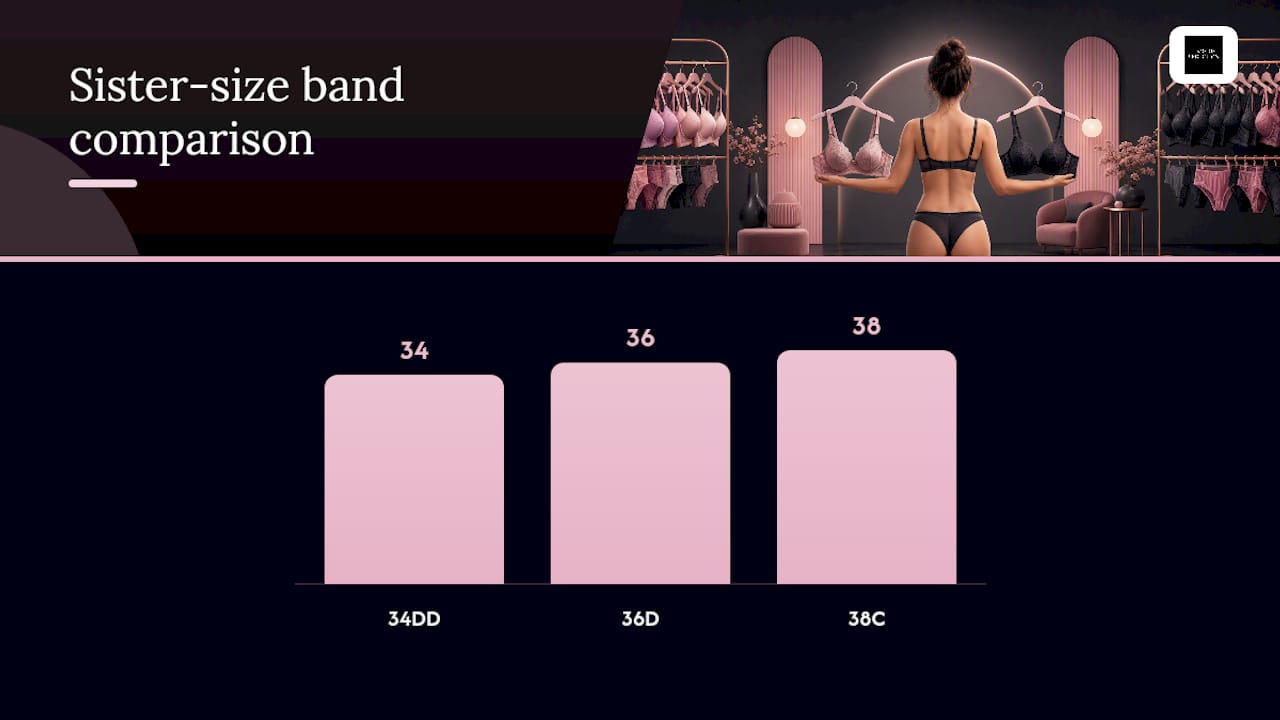
Sister sizing solves the single most common fitting problem: a bra that fits in the cup but not the band, or vice versa. The rule is straightforward. Move one band size down and one cup size up, or one band size up and one cup size down, and the cup volume stays roughly the same.
A 36D, for example, sits in the same volume family as a 34DD and a 38C. The band changes the ribcage fit; the cup letter shifts to keep the actual breast volume equal across that change.
- Try your calculated size first, using the underbust and full-bust measurements from earlier.
- If the band feels loose or rides up within the first few wears, size down one band and up one cup. A 36D becomes a 34DD. This keeps the same cup volume but tightens the ribcage fit.
- If the band is right but the cups spill or gape, adjust the cup only, without necessarily changing the band, unless the band also fails the two-finger test.
- If the cup feels too big and the wire sits off your ribcage at the sides, size up one band and down one cup. A 36D becomes a 38C. This loosens the band slightly while keeping volume consistent.
- Try two sister sizes side by side in the change room rather than guessing from one attempt. Run both through the fit checklist and see which one passes the backward-band test and the gore check without gaping.
Sister sizing exists because cup letters are relative, not absolute. A D cup on a 32 band holds far less volume than a D cup on a 40 band, which is why the same cup letter can feel completely wrong when you change bands. Lingerie Seduction’s piece on trying two sister-size bras and keeping the better one walks through this exact comparison method if you want a longer read.
Common full bust fit problems and quick fixes
Most fit complaints trace back to one of four issues, and each has a fast, testable fix.
- Band rides up at the back. This is almost always a band that’s too big. Go down a band size and up a cup to compensate, then recheck with the backward-band test.
- Straps dig in or leave marks on your shoulders. Widen the straps if the bra allows it, but check the band first. Straps that dig in are often compensating for a band that isn’t supporting enough weight on its own. A leotard-back or centre-pull strap design can also redistribute pressure more evenly.
- Cups gape at the top or wrinkle in the fabric. This is a shape mismatch, not usually a size mismatch. Try a seamed cup instead of a smooth mould, or a different cup height. If one side is smaller due to natural asymmetry, a thin removable pad on that side can even things out without changing your overall size.
- Underarm spillage or wire pain at the sides. Look for a style with side support panels and a wider wire footprint that matches your root width. If the wire consistently digs in at the same spot across different brands, that brand’s wire shape probably doesn’t suit your chest wall curve, and it’s worth trying a different construction entirely.
How Support for full bust customers
Fit content is built around the same measure-then-check method covered here, with dedicated guides on measuring at home and choosing between sister sizes when a fit sits on the edge between two options.
Two catalogue pieces suit fuller-bust shoppers looking for structured support with a statement edge:
- The Sheer Nude Mesh Faux Leather Bra Set pairs faux leather panelling with sheer mesh, giving a firmer structured base under the bust while keeping a soft, sheer finish through the cup.
- The Faux Leather & Mesh Black Bustier With Gstring offers a longline structured fit, useful if you find a full-cup bra shape more comfortable when it extends further down the ribcage for extra band support.
Shopping practicalities matter just as much as fit advice. Orders over a certain amount ship free, and returns are hassle-free within a reasonable period if a size doesn’t land right the first time, and every parcel goes out in discreet packaging with fast local dispatch.
Fit is about comfort first, confidence second
The biggest myth in bra fitting isn’t about measurements. It’s the idea that a “correct” size is a fixed number you get once and never revisit. Bodies change with weight fluctuation, hormones, and time, and the size that fit perfectly two years ago might be actively working against you now.
Fuller busts get a rough deal from generic sizing advice built around average-chest assumptions. A cup letter isn’t a judgement or a category, it’s just a ratio between two measurements. Treating it that way removes a surprising amount of the anxiety that comes with bra shopping.
The most practical thing you can do this week is simple: measure properly, try two sister sizes side by side, and run both through the fit checklist before deciding. If neither works, send it back and try again. That’s what returns policies are for.
— Lingerie Seduction
Ready to find your fit? Start with two sizes, not one
Most bra shopping goes wrong because women buy one size, wear it uncomfortably for months, and never try the sister size that would have solved everything. Lingerie Seduction makes that comparison easy: order your calculated size plus one sister size, keep whichever passes the fit checklist, and return the other.

The Sheer Nude Mesh Faux Leather Bra Set works well as a first size-test piece thanks to its structured band, and if you’re after fuller coverage with a longline silhouette, the Faux Leather & Mesh Black Bustier With Gstring is worth trying in your two closest sizes. Browse the wider lingerie sets or corsets and bustiers range if you want more structured options to compare side by side.
Orders over a certain amount ship free, and returns are accepted within a reasonable period if the fit isn’t right. Start on the loosest hook, try both sizes at home, and send back whichever one doesn’t earn its place in your drawer. Browse the full range to get started.
Sources
FAQ
What size is considered a full bust?
There’s no single cut-off, since cup size is relative to band size, but a full bust generally refers to a four-inch or greater difference between underbust and full-bust measurements, landing in a D cup or above on most sizing charts.
What is the 3 bra rule?
There isn’t one universally recognised “3 bra rule” in fitting guides, but a common practical version is trying three variations, your calculated size plus two sister sizes, before deciding which one passes the fit checklist.
What type of bra is most flattering for large breasts?
Full-cup or three-part seamed encapsulation styles tend to work best, since they fully contain breast tissue and follow natural shape rather than forcing it into a single mould. Balconette styles with side support panels suit a lower neckline without losing containment.
How should a bra fit for large breasts?
The band should sit level and firm on the loosest hook, the centre gore should lie flat against your sternum with no gap, and the cups should fully enclose your breast tissue without spilling, gaping, or wrinkling. Straps shouldn’t carry the weight, and wires should rest on your ribcage, never on breast tissue itself.


