

Try 2 Sister Size Bras, Keep the Best. Aussie Fit, Easy Returns
A sister size keeps roughly the same cup volume while moving the band up or down. Try one only when the cup already fits well but the band is too tight, too loose, or riding up. To go firmer, drop the band and go up a cup. To go roomier, increase the band and drop a cup.
TL;DR:
- Sister sizes maintain the same cup volume but involve changing the band and cup label, with a two-band, one-cup adjustment being the standard approach.
- Variations between brands, styles, and international sizing systems limit how precisely sister sizes match, relying on approximations rather than guarantees.
- Confirm your current size accurately by measuring under the bust and bust at their fullest, then try sister sizes if band fit issues are caused mainly by band tightness or looseness.
- Testing a firmer or roomier sister size can resolve band ride-up, digging, or support issues, provided the fit checklist confirms the back is level and cups sit properly.
- Ordering both the current and sister sizes allows you to compare fit and choose the most comfortable option, with hassle-free return policies reducing the risk of trying multiple sizes.
Table of Contents
- What is a sister size bra? Understanding cup volume
- How to calculate your sister size (and confirm your starting point)
- When a sister size fixes the problem (and how to check it worked)
- Sister size examples and a quick reference chart
- Why our sizing guides and returns policy make trying sisters low-risk
- Adjusting sister sizes across balconette, plunge, and sports styles
- Does a sister size change how your breasts look?
- Tips for trying on multiple sister sizes at once
- Common misconceptions about sister sizing
- Fit-team perspective: when we suggest sister sizing in practice
- Two supportive sets to try once you know your size
- Sources
- FAQ
What is a sister size bra? Understanding cup volume
A sister size bra isn’t a different bra at all. It’s the same cup volume, packaged in a different band and cup label combination. Bra sizing works on a sliding scale: as the band number changes, the cup letter has to shift too, or the actual volume inside the cup changes with it. A 32D and a 34C hold roughly the same cup volume, just sitting on different-sized frames. That’s the entire logic behind sister sizing, and it’s why the technique works so reliably once you understand what it isn’t.
It isn’t a universal fix. A few things limit how far you can trust a sister size:
- Brand and style variation. Wire width, cup shape, and fabric stretch differ enough between brands that a sister-size move is always an approximation, never a guarantee.
- Cup shape mismatches. A projected cup and a shallow cup of the same volume won’t sit the same way on everybody.
- International label differences. A US 34 isn’t automatically an EU or French 34. Band numbers map differently across measuring systems, inches versus centimetres, so always check a proper size chart before assuming a label carries over.
Once you’ve got the cup fitting well in your current size, sister sizing gives you a genuine shortcut. Skip it if the cups themselves are wrong. That’s a different problem, and no band swap will solve it.
How to calculate your sister size (and confirm your starting point)
Before you touch a sister size, confirm your current size is actually close. Measure firmly under the bust, where the band sits, and around the fullest part of the bust in a well-fitting (or your best-guess) bra. The difference between those two numbers points you toward your starting cup letter, and our measuring guide walks through the exact technique if you want a refresher.
Once you know your current size, the calculation itself is simple:
- Band too loose or riding up? Go down one band size and up one cup letter. A 34C becomes a 32D.
- Band too tight or digging in? Go up one band size and down one cup letter. A 34C becomes a 36B.
- Try it on. Fasten it on the loosest hook, check the band sits level, and run through the fit checklist below.
- Decide. If it fits better, that’s your new working size. If something still feels wrong, remeasure rather than trying a third sister size blind.
That two-band, one-cup swing is the rule fitters use everywhere, and it’s consistent across sizing charts and calculators.
Pro Tip: Keep a running note on your phone of every sister size you’ve tried and how it fit in each brand. Bra sizing isn’t standardised, so your personal sister-size shortlist becomes more useful than any generic chart after two or three fittings.
When a sister size fixes the problem (and how to check it worked)
Certain symptoms point directly at a band problem rather than a cup problem, and those are exactly when sister sizing earns its keep:
- The band rides up your back within an hour of putting the bra on.
- The band digs in or leaves red marks, even on the loosest hook.
- You’re already on the tightest hook and still loose, with cups that fit well.
- Your usual size is sold out and you need a same-volume substitute in a pinch.
If any of those sound familiar, a sister size is worth testing before you buy a new brand or style entirely.
Confirming it actually worked means running through a short fit check, not just glancing in the mirror:
- The back band sits level, parallel to the floor, not riding up at the back.
- The centre gore tacks flat against your sternum.
- No spilling over the cup edge, and no gaping or empty space in the cup.
- The underwire follows your ribcage, not resting on breast tissue.
- Straps stay put without digging in or sliding off.
If the sister size clears every one of those checks, keep it. If the band’s fixed but the cup still gapes or spills, the fix is a different cup shape, not another sister size — that calls for remeasuring, not another band swap.
Sister size examples and a quick reference chart
Seeing sister sizes mapped out makes the pattern click faster than any explanation. Take a 34C: its sisters are a 32D (firmer band, same volume) and a 36B (roomier band, same volume). A 34D works the same way, sistering to 32DD on the tighter side and 36C on the looser side. Notice the double letter, DD isn’t a typo, it’s simply where the cup-letter sequence lands once you cross that particular band threshold, and it trips up a lot of shoppers converting between systems for the first time.
A 36C sisters down to 34D and up to 38B, and a 32A at the smaller end sisters to 30B and 34AA. The pattern holds at nearly every point on the chart, which is what makes sister sizing so reliable as a first move.
| Your current size | Firmer band sister | Roomier band sister |
|---|---|---|
| 32A | 30B | 34AA |
| 34C | 32D | 36B |
| 34D | 32DD | 36C |
| 36C | 34D | 38B |
| 36D | 34DD | 38C |
Treat this table as a starting shortlist, not a guarantee. Brands cut wires and cups differently enough that the only real confirmation is trying the bra on and running it through the fit checklist above.
Why our sizing guides and returns policy make trying sisters low-risk
Guessing at a sister size only works if getting it wrong doesn’t cost you anything. That’s the practical reason stores back every purchase with policies built for exactly this kind of trial and error:
- Our Australian size chart converts between systems so you’re not guessing at label equivalents.
- Shipping thresholds and returns policies allow for easy exchanges if a sister size doesn’t land right.
- Our size-selection guide covers what to do if you’re stuck between two sizes when ordering online.
Order two sister sizes side by side if you’re torn. Keep the one that passes the fit checklist, return the other.
Adjusting sister sizes across balconette, plunge, and sports styles
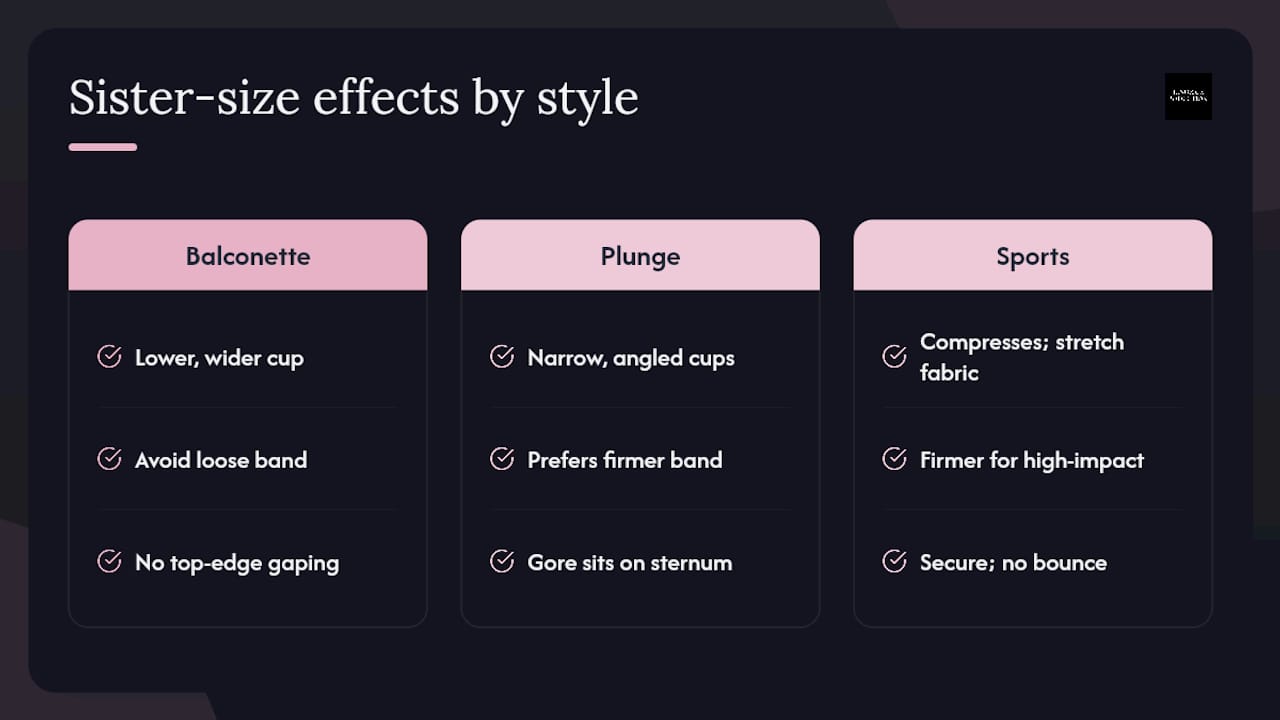
Sister sizing behaves differently depending on the style, because each cut distributes cup volume across a different shape.
Balconette bras cut lower and wider across the cup, so a sister size with a slightly deeper cup letter can look shallow in a balconette even if the volume is technically correct. If you’re sistering up in cup and down in band for a balconette, check the top edge of the cup isn’t gaping, that’s the tell that the shape doesn’t suit that particular sister.
Plunge bras narrow the centre gore and angle the cups inward, so a firmer-band sister (down two band, up one cup) often works better here than the roomier option. A looser band on a plunge style tends to let the gore float away from the sternum, which defeats the low centre-front the style exists for.
Sports bras compress rather than cup-shape, so sister sizing applies more loosely. A firmer-band sister generally gives better lockdown for high-impact activity, while a roomier sister suits lower-impact wear where comfort matters more than compression. Because sports styles often use stretch fabric across the band, the two-band jump can feel less dramatic than it does in an underwire bra, so try both directions if you’re unsure.
Across all three, the rule holds: calculate the sister, then judge it against the style’s own job, not just the numbers.
Does a sister size change how your breasts look?
Yes, slightly, and it’s worth expecting before you try one on. Because a sister size shifts where the cup sits on your ribcage and how the band anchors, the same cup volume can look rounder in one sister and more projected in another.
Sistering down in band and up in cup (the firmer option) tends to lift and centre the bust more, since a tighter band gives the wires a more stable base to work from. Some wearers find this option more flattering under fitted tops, and it’s part of why a firmer-band sister is often preferred for sports or strapless styles, where a stable anchor matters more than a relaxed fit.
Sistering up in band and down in cup (the roomier option) spreads the same volume across a wider frame, which can soften the shape and reduce projection slightly. Neither look is wrong, they’re just different presentations of the same cup volume, and which one suits you depends on the top you’re wearing it under and your own preference for a rounder versus a more natural shape.
The one thing a sister size won’t change is your actual breast tissue volume. If a sister size makes your bust look noticeably smaller or larger rather than just differently shaped, that’s a signal the cup wasn’t matched correctly in the first place, and it’s worth remeasuring rather than continuing to sister size in that direction.
Tips for trying on multiple sister sizes at once
Testing more than one sister size in a single sitting saves you a return cycle, provided you do it methodically rather than guessing your way through.
Order your current size alongside both sisters, the firmer option and the roomier one, if your budget allows it. Trying all three back to back, in the same style, is the fastest way to feel the actual difference in band tension rather than relying on memory between separate try-ons days apart.
Fasten each on the loosest hook first. This gives you room to tighten as the band naturally relaxes with wear, and it’s a more honest first impression than starting on the tightest hook, which can mask a band that’s genuinely too big.
Move around in each one before deciding. Raise your arms, lean forward, then stand straight and check the band again. A band that looks level standing still but rides up the moment you lift your arms hasn’t actually solved the problem.

Give each sister a few minutes on your body rather than judging in the first ten seconds. Wire placement and band tension both settle slightly once the bra warms to your body temperature, and a size that feels tight on first fasten can ease into comfortable within a couple of minutes.
Compare cup fill last, once you’ve settled on the band that behaves best. The cup should be the tiebreaker between two otherwise comfortable sisters, not the first thing you judge.
Common misconceptions about sister sizing
“A sister size means the bra runs small or large.” It doesn’t. Sister sizes aren’t about brand sizing running generously or tightly, they’re a fixed mathematical relationship between band and cup that holds true regardless of how a brand cuts its patterns. What varies by brand is fit within a size, not the sister-size logic itself.
“Any sister size will work as a substitute.” Only the direction that matches your actual problem works. If your band is too loose, the roomier sister won’t help, it makes the same problem worse. Sister sizing is directional, and picking the wrong direction is the single most common mistake shoppers make with it.
“Sister sizing fixes cup problems.” It doesn’t, and this is worth repeating because it’s the most persistent myth around the technique. Sister sizes exist to solve band problems, not cup shape, cup projection, or cup coverage issues. If the cups gape or spill in your current size, sistering the band won’t touch that.
“Every letter means the same thing across brands and countries.” It doesn’t. A D cup in one country’s sizing system doesn’t necessarily match a D cup in another, and checking a proper conversion chart matters more than trusting the letter whenever you’re shopping across systems, particularly if you’re buying from an international brand for the first time.
“You only ever need one sister size.” Some bodies suit the firmer-band sister for certain styles and the roomier one for others. There’s no rule that says you have to pick a single sister size and use it everywhere.
Fit-team perspective: when we suggest sister sizing in practice
We point customers toward a firmer-band sister far more often than the roomier option, because a loose band is the single most common complaint we hear, riding up, losing support, hooks already maxed out. A roomier sister comes up less often, usually for someone moving into a softer, lower-impact style.
The habit that saves people the most second-guessing is writing down every sister size tried, in which brand, with the result. Bra sizing isn’t standardised enough for one chart to override real fit data from your own body. If you’re still unsure after that, our measuring guide is the better starting point than another round of sister-size guessing.
— Lingerie Seduction
Two supportive sets to try once you know your size
Once you’ve worked out your size and your best-fit sister, ordering becomes a lot less risky. Two sets worth trying if you’re testing a new size are the Pink & White Lace 3 Piece Bra Set and the White Half Cup Lace Bra & Panty Set, both available across a full size range so you can order your current size and a sister side by side without hunting for stock elsewhere.

Start by measuring underbust and bust, then decide whether your band problem calls for the firmer or roomier direction. If you’re between two sizes, order both, the Pink & White Lace 3 Piece Bra Set in your current size and a sister, and keep whichever passes the fit checklist. The White Half Cup Lace Bra & Panty Set works the same way if a half-cup shape suits you better than a full cup.
Free shipping applies on orders over $100, and returns are hassle-free if a size doesn’t land right the first time. Browse the full range now and order the size, or the sister, that fits.
Sources
- Bra Sister Sizes: Same Cup Volume Chart
- Bra Size Chart 2026: Every Band & Cup, One Page
- Band and cup equivalents across sizing systems
- International Bra Size Conversion Chart | Bra Size Calculator
FAQ
What is a sister size in a bra?
A sister size is a bra with the same cup volume as your current size but a different band and cup letter combination, useful when your cup fits but your band doesn’t.
What are the sister sizes for common Australian bra sizes?
Australian sizing follows the same US/UK inch-based system, so a 34C sisters to a 32D (firmer band) and a 36B (roomier band), and the same two-band, one-cup rule applies across the range.
Is 34C a sister size to 36B?
Yes. A 34C and a 36B share roughly the same cup volume, with the 36B offering a roomier band and the 32D offering a firmer one.
What’s a sister size to a 34D?
A 34D sisters to a 32DD for a firmer band or a 36C for a roomier band, both carrying the same cup volume as the original size.
Tags
sister size bra, bra size equivalents, sister size chart bra, bra fitting guide, understanding bra sizes, bra sister sizes, find your sister size, bra size comparison


