

Why cotton lingerie is breathable: comfort and skin health
Yes, cotton lingerie is breathable. Cotton fibres allow higher air permeability than most synthetics in everyday dry conditions, and the fabric absorbs moisture that then evaporates away from the skin. That combination keeps the microclimate around sensitive skin drier, which reduces irritation and lowers the risk of bacterial and yeast overgrowth.
The core reasons cotton breathes well:
- Fibre porosity: Cotton is a natural plant fibre with a hollow lumen structure that creates tiny air channels throughout the yarn.
- Air permeability: Under ASTM D737 lab testing, cotton woven fabric demonstrated higher air permeability than equivalent polyester in dry conditions, with cotton recording 159.58 cc/s/cm² and polyester 139.85 cc/s/cm²—a ~14% advantage for cotton.
- Hydrophilic absorption: Cotton absorbs moisture into the fibre itself rather than leaving it sitting on the skin surface.
- Practical implication: For daily wear, a 100% cotton gusset keeps the vulvar microclimate drier and is less likely to trigger irritation than synthetic alternatives.
Quick signals to look for when shopping: 100% cotton crotch panel, light GSM (under 150 where possible), plain weave or open mesh knit.
Pro Tip: When activity will cause heavy sweating, switch to moisture-wicking synthetics during exercise, then change back into cotton afterwards to restore skin comfort.
Table of Contents
- Why cotton lingerie is breathable: the fibre and fabric science
- How cotton handles moisture and what that means in practice
- How cotton compares with other common lingerie fabrics
- Skin health and comfort benefits of cotton lingerie
- When cotton is not the best choice
- How to choose breathable cotton lingerie in Australia
- What the lab data actually says about breathability testing
- Quick buying and care checklist
- Key takeaways
- Lingerie Seduction’s take on fabric and comfort
- Breathable lingerie at Lingerie Seduction
- Useful sources
- FAQ
Why cotton lingerie is breathable: the fibre and fabric science
Cotton’s breathability starts at the fibre level, as seen in breathable designs like the breathable seamless wave point sexy tube top that combine style and ventilation. Each cotton fibre is a natural cellulosic strand with a central lumen, a hollow channel that runs along its length. That structure creates tiny air pathways within the yarn itself, before weave even enters the picture.
Weave and fabric weight then amplify or reduce that advantage significantly. A plain weave or open mesh knit leaves more inter-yarn gaps than a tight twill or sateen, so air moves through more freely. Fabric weight and weave structure can shift breathability more than fibre identity alone; a lightweight polyester mesh can outperform a heavy cotton twill. For lingerie, this means checking GSM matters as much as checking the fibre label.
Stat callout: Under ASTM D737 standardised air-permeability testing, cotton woven fabric recorded 159.58 cc/s/cm² compared to polyester at 139.85 cc/s/cm² in equivalent construction in dry conditions. That represents a measurable and consistent ~14% advantage for cotton across multiple lab comparisons.
Features that improve breathability in cotton lingerie:
- Low GSM (roughly 100–150 for underwear)
- Plain weave or open knit construction
- 100% cotton gusset with no synthetic lining
- Minimal chemical finishes or coatings
- Loose or relaxed fit that does not compress the fabric against skin
Understanding how lingerie fabrics are made helps you read these construction details before you buy.
How cotton handles moisture and what that means in practice
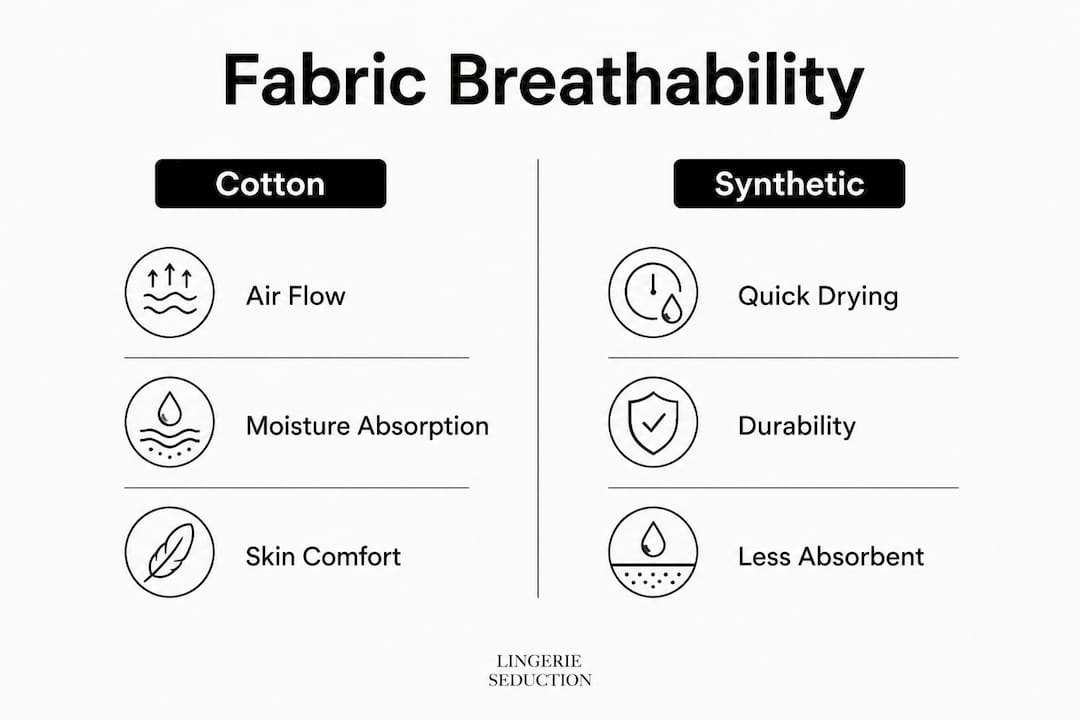
Cotton is hydrophilic, meaning it actively draws moisture into the fibre rather than repelling it. Its equilibrium moisture regain sits around 7–8.5% at standard conditions (65% relative humidity, 20°C), which is far higher than polyester at roughly 0.4%. In practical terms, cotton absorbs sweat before it pools on the skin surface, which is why it feels comfortable during light activity and warm weather.
The limitation appears when sweating becomes heavy. As cotton fibres absorb moisture they swell, reducing the inter-yarn gaps that allow air to pass through. Lab data shows this crossover effect: the dry-condition air-permeability advantage narrows or reverses once the fabric is saturated, because synthetics do not swell the same way. A saturated cotton gusset can feel damp and clammy rather than cool.
Stat callout: Cotton’s moisture vapour transmission rate (MVTR) is higher than nylon in comparative textile testing, supporting a drier microclimate during normal daily wear.
For daily wear and sensitive skin, cotton’s absorption is a genuine advantage. For endurance exercise or very humid conditions, it becomes a drawback.
Pro Tip: After a workout, change out of synthetic performance underwear and into cotton as soon as possible. The switch lets your skin breathe and recover, and reduces the time spent in a warm, damp microclimate.
How cotton compares with other common lingerie fabrics
Fibre choice involves real trade-offs between breathability, moisture transport, drying speed, and appearance. The table below summarises how common lingerie fabrics compare on the axes that matter most for comfort and skin health.
| Fabric | Air permeability (dry) | Moisture transport | Drying speed | Skin sensitivity risk | Best use case |
|---|---|---|---|---|---|
| 100% cotton (plain weave) | 159.58 cc/s/cm² | Absorbs into fibre | Slow | Low | Daily wear, sensitive skin |
| Polyester | 139.85 cc/s/cm² | Wicks to surface | Fast | Moderate | Exercise, activewear |
| Nylon | Moderate | Wicks to surface | Fast | Moderate | Shapewear, low-VPL styles |
| Modal (regenerated cellulosic) | Moderate–high | Absorbs, softer hand | Moderate | Low | Warm-weather dresses, sleepwear |
| Microfibre | Low–moderate | Surface wicking | Fast | Low–moderate | Invisibility under clothing |
| Lace overlay (synthetic) | Variable | Minimal absorption | Fast | Moderate | Aesthetic/occasion wear |
| Cotton blend | Moderate | Partial absorption | Moderate | Low | Compromise for active days |
A few practical points the table does not fully capture:
- Cotton gusset rule: Even when the outer fabric is lace or microfibre, a 100% cotton gusset keeps the skin-contact zone breathable and absorbent. Outer synthetic panels can trap heat, but the gusset is what touches the vulva directly.
- Lace overlays reduce breathability compared with plain cotton because the tighter weave and synthetic content restrict airflow. Lace pieces like the Sheer White Lace Mesh Teddy Bodysuit prioritise aesthetics; pairing them with a cotton-lined gusset recovers the skin-health benefit.
- Modal sits between cotton and synthetics: softer than standard cotton, more breathable than polyester, but slower to dry than nylon.
- Cotton versus microfibre comparisons consistently show cotton as the default for breathability and absorbency, while microfibre wins on smoothness and invisibility under tight clothing.
For everyday comfort, cotton or modal with a cotton gusset is the practical choice. For low-VPL needs under fitted clothing, microfibre or nylon works better, provided the gusset remains cotton-lined.
Skin health and comfort benefits of cotton lingerie
Cleveland Clinic guidance recommends cotton underwear for everyday wear specifically because it reduces the moisture that bacteria and yeast thrive on, and because it is less likely to cause allergic reactions than many synthetics. For women with recurrent vulvar or vaginal issues, choosing breathable, 100% cotton underwear is one of the most consistent clinical recommendations.

The mechanism is straightforward. A drier microclimate around the vulva means less opportunity for Candida species and anaerobic bacteria to proliferate. Cotton’s absorption draws sweat away from the skin surface, and the higher MVTR allows that moisture to evaporate rather than accumulate. Synthetic fabrics that wick moisture to the surface can still leave it trapped against the skin if the garment fits closely.
Skin sensitivity adds another dimension. Organic cotton is grown without harsh pesticides and processed without certain chemical finishes, which lowers the risk of contact dermatitis in reactive skin. Long-staple varieties such as Pima cotton are softer and less likely to retain irritating residues than standard short-staple cotton.
Trust signal: Clinical guidance consistently points to breathable cotton as the preferred fabric for women with recurrent vulvar irritation or sensitivity, with 100% cotton preferred over cotton-blend outer shells.
Construction details matter too:
- Exposed elastics can abrade sensitive skin; look for covered waistbands.
- Synthetic-lined crotches negate the cotton benefit even when the outer fabric is labelled cotton.
- Dye residues in heavily pigmented fabrics can irritate reactive skin; undyed or OEKO-TEX certified options reduce this risk.
- Elastic placement and design affect both comfort and airflow around the leg openings.
When cotton is not the best choice
Cotton performs well in everyday, low-to-moderate activity conditions. Under sustained heavy sweating, it loses that advantage. As fibres swell with absorbed moisture, airflow drops and the fabric stays damp against the skin for longer than a synthetic would. During endurance exercise, a saturated cotton gusset can cause chafing and keep the microclimate warm and wet, which is the opposite of what you want.
Practical alternatives by scenario:
- Endurance exercise or high-intensity training: Moisture-wicking polyester or nylon blends move sweat to the fabric surface where it evaporates quickly. Look for seamless or flatlock-seamed styles to reduce friction.
- Very humid climates or long travel days: Lightweight modal or bamboo viscose offers softer contact than polyester while drying faster than cotton.
- Invisibility under fitted clothing: Microfibre or nylon with a cotton gusset gives a smooth silhouette without sacrificing the skin-contact benefit.
- Occasion wear: Lace and sheer pieces like the Exotic Bloom Lace Crotchless Teddy or Delicate Sheer Lace Bridal Sleepwear prioritise aesthetics over all-day breathability, which is a reasonable trade-off for short-duration wear.
Fit matters as much as fabric. A tight cotton style compresses the weave, reduces inter-yarn gaps, and traps heat just as a synthetic would. A relaxed or semi-fitted cut preserves the airflow advantage.
Pro Tip: Keep a pair of cotton underwear in your gym bag. Change into them after your workout and shower; the switch from performance fabric back to cotton helps restore the skin’s natural microclimate faster.
Quick rules:
- Activity with heavy sweating: use moisture-wicking synthetics.
- Daily wear, sensitive skin, warm weather at rest: use cotton.
- Recovery after exercise: switch to cotton as soon as practical.
- Occasion wear under 2–3 hours: lace or sheer styles are fine.
How to choose breathable cotton lingerie in Australia
Buying genuinely breathable cotton lingerie requires reading past the marketing label. Here is a practical checklist for Australian shoppers.
-
Check the gusset label, not just the outer fabric. A garment labelled “cotton blend” may have a polyester outer shell with only a small cotton panel. Look for “100% cotton gusset” or “cotton-lined crotch” stated explicitly on the label or product page.
-
Look for a low GSM. Lightweight plain weave cotton under roughly 150 GSM breathes noticeably better than heavier constructions. Percale and jersey knits in this range are good options for underwear.
-
Prefer plain weave or open knit over tight weaves. Sateen and twill constructions look smooth but restrict airflow. Open knit and mesh structures allow more air movement even at the same GSM.
-
Check for certifications on sensitive-skin pieces. OEKO-TEX Standard 100 certification means the fabric has been tested for harmful substances. GOTS (Global Organic Textile Standard) certification confirms organic fibre and processing. Both reduce the risk of chemical residue irritation.
-
Assess the fit. Overly tight cuts compress the fabric and reduce breathability regardless of fibre. A relaxed or semi-fitted style preserves the air-permeability advantage. Check that leg openings do not dig in, as that traps moisture at the crease.
-
Avoid daily panty liners unless clinically required. Clinical guidance notes that liners decrease ventilation and increase moisture trapping, which can negate the benefit of a breathable cotton garment entirely.
-
Read the care label before washing. Hot water and tumble drying degrade cotton fibres over time and can shrink the fabric, tightening the weave. Cold or warm machine wash and air drying preserves both fit and breathability.
Pro Tip: Avoid fabric softener on cotton underwear. Softener coats the fibres with a waxy residue that reduces absorbency over time. Use a gentle, fragrance-free detergent instead.
For broader fabric guidance, top fabrics in lingerie covers the most common constructions and their comfort trade-offs.
What the lab data actually says about breathability testing
ASTM D737 is the standard test method for air permeability of textile fabrics. A circular fabric sample is clamped over a test head, and a known pressure differential is applied. The result, expressed in cubic centimetres of air per second per square centimetre (cc/s/cm²), tells you how freely air moves through the fabric under controlled conditions. Higher numbers mean more airflow.
The 14% cotton advantage over polyester (159.58 vs 139.85 cc/s/cm²) comes from dry-condition testing. That is the relevant scenario for everyday wear at rest. The caveat is that cotton fibres swell when wet, reducing inter-yarn gaps and narrowing or reversing that advantage during heavy sweating. Lab tests measure a single controlled state; real wear involves changing humidity, body heat, and movement.
Stat callout: Cotton’s equilibrium moisture regain of 7–8.5% is roughly 20 times higher than polyester’s (~0.4%), which explains why cotton absorbs more moisture but also why it stays damp longer once saturated.
MVTR (moisture vapour transmission rate) measures how much water vapour passes through a fabric per unit area per hour. It is a different metric from air permeability and captures evaporation rate rather than raw airflow. Both matter for comfort, but neither fully replicates the sweaty, moving, body-heat microclimate of real wear.
| Metric | What it measures | Cotton result | Polyester result |
|---|---|---|---|
| Air permeability (ASTM D737, dry) | Airflow through fabric | 159.58 cc/s/cm² | 139.85 cc/s/cm² |
| MVTR | Moisture vapour escape rate | ~535–538 g/m²·h | Lower (varies by construction) |
| Moisture regain | Fibre absorption capacity | 7–8.5% | ~0.4% |
Pro Tip: When reading fabric marketing claims, ask whether the data comes from dry or wet testing. A brand citing air-permeability numbers without stating test conditions may be quoting the most favourable scenario.
Quick buying and care checklist
Use this list before you purchase or wash cotton lingerie.
- 100% cotton gusset stated on the label, not just “cotton blend” outer fabric.
- GSM under 150 for everyday underwear; lighter is generally more breathable.
- Plain weave or open knit construction preferred over sateen or twill.
- OEKO-TEX or GOTS certified for sensitive or reactive skin.
- Relaxed or semi-fitted cut to preserve inter-yarn airflow.
- No daily panty liners unless clinically required; they trap moisture and reduce ventilation.
- Swap to synthetics for exercise, then change back into cotton after showering.
- Cold or warm machine wash, air dry, no fabric softener.
Cotton is the best everyday choice for breathability and skin health in normal, low-to-moderate activity conditions. For exercise or heavy sweating, performance fabrics work better during the activity itself.
Pro Tip: Keep at least two or three cotton pairs in rotation so you always have a fresh, dry pair to change into after exercise or a warm day. Changing promptly reduces the time your skin spends in a damp microclimate.
Key takeaways
Cotton lingerie is breathable in everyday dry conditions because its fibre structure and plain weave constructions allow higher air permeability than most synthetics, with a measurable advantage over polyester under ASTM D737 testing.
| Point | Details |
|---|---|
| Air permeability advantage | Cotton has a measurable advantage over polyester in dry ASTM D737 testing, with 159.58 cc/s/cm² for cotton versus 139.85 cc/s/cm² for polyester—a 14% difference. |
| Moisture absorption trade-off | Cotton’s 7–8.5% moisture regain absorbs sweat well but causes fibre swelling that reduces breathability when saturated. |
| Skin health guidance | Cleveland Clinic-style guidance recommends 100% cotton underwear to reduce moisture that supports bacterial and yeast growth. |
| Fabric and weave matter | GSM and weave structure can shift breathability more than fibre identity; choose plain weave under 150 GSM. |
| Lingerie Seduction options | Lingerie Seduction stocks cotton-lined and breathable-construction pieces suited to daily wear and sensitive skin. |
Lingerie Seduction’s take on fabric and comfort
The science is clear enough: cotton is the practical default for daily wear and sensitive skin, and performance fabrics are the right call during exercise. What gets overlooked is that the gusset construction matters more than the outer fabric label for most women. A lace or sheer outer shell is fine for occasion wear or short-duration use; the skin-health benefit lives in what lines the crotch panel, not what you see in the mirror.
Lingerie Seduction’s range includes cotton-lined pieces and breathable constructions alongside lace, sheer, and statement styles. The practical approach is to match the fabric to the occasion: cotton-lined everyday styles for daily comfort, and aesthetic pieces for the times when appearance takes priority over all-day ventilation. Both have a place in a well-stocked drawer.
For readers dealing with persistent skin sensitivity or recurrent irritation, the fabric checklist in this article is a useful starting point, but a GP or gynaecologist can give guidance specific to your situation.
Breathable lingerie at Lingerie Seduction
Cotton-lined and breathable-construction pieces are available now at Lingerie Seduction, with free shipping on orders over $100 and hassle-free returns.

For everyday comfort, look for styles with a 100% cotton gusset in the product description. For occasion wear where aesthetics come first, pieces like the Sheer White Lace Mesh Teddy Bodysuit and the Exotic Bloom Lace Crotchless Teddy offer styles with a cotton-lined construction option. Bridal shoppers can find sheer, elegant options in the Delicate Sheer Lace Bridal Sleepwear range. Browse the full collection at Lingerie Seduction and filter by fabric type to find the right fit for your skin and lifestyle.
Useful sources
The claims in this article draw on the following sources. For readers who want to go deeper, these are the most useful starting points.
- Cleveland Clinic: how underwear impacts vaginal health — clinical guidance on fabric choice, gusset construction, and the role of liners in vulvovaginal health.
- Lab air-permeability data: cotton vs polyester (ASTM D737) — the primary source for the 159.58 vs 139.85 cc/s/cm² figures and moisture regain data cited throughout.
- Science Insights: is cotton best for underwear? — MVTR comparison data (cotton ~535–538 g/m²·h vs nylon ~490–508 g/m²·h) and a balanced assessment of cotton’s strengths and limits.
- Julie May: the science behind organic cotton — evidence on organic cotton and reduced dermatitis risk for sensitive skin.
Stat callout: Cotton’s air permeability is 159.58 cc/s/cm² compared to polyester at 139.85 cc/s/cm² in dry ASTM D737 testing, giving a 14% advantage for cotton—the most cited lab figure in breathability comparisons. Read it alongside moisture regain data (7–8.5% for cotton vs ~0.4% for polyester) to get the full picture.
When interpreting lab numbers, prefer sources that publish their test method (ASTM D737 for air permeability, ISO 139 for moisture regain, MVTR for evaporation rate). Numbers without a stated method are difficult to compare across studies. For persistent skin issues, consult a GP or dermatologist rather than relying on fabric choice alone.
FAQ
Is 100% cotton the most breathable underwear fabric?
In dry, everyday conditions, 100% cotton plain weave has higher air permeability than polyester and nylon of equivalent construction, making it one of the most breathable options for daily wear. Lightweight modal is comparable, and some open-mesh synthetics can match cotton at very low GSM.
Is 100% cotton too hot for summer?
Lightweight cotton under roughly 150 GSM is well suited to warm weather because its higher air permeability and moisture absorption keep the skin-contact zone drier. Heavy cotton constructions (220+ GSM twill) can feel warm, so fabric weight matters as much as fibre choice in summer.
Does cotton underwear actually reduce infection risk?
Cleveland Clinic guidance recommends cotton underwear for everyday wear because it reduces the moisture that bacteria and yeast thrive on and is less likely to cause allergic reactions than many synthetics. It is a supportive measure, not a standalone treatment; persistent issues warrant medical advice.
Should I avoid panty liners if I wear cotton underwear?
Clinical guidance notes that daily liners decrease ventilation and increase moisture trapping, which can negate the breathability benefit of a cotton garment. Avoid them unless clinically required.
Does fabric softener affect cotton’s breathability?
Fabric softener deposits a waxy coating on cotton fibres that reduces absorbency over repeated washes. Use a gentle, fragrance-free detergent and air dry to preserve the fabric’s natural breathability and moisture-absorption properties.
Tags: cotton lingerie, breathable underwear, skin health, fabric guide, lingerie care, cotton vs synthetic, everyday lingerie, sensitive skin, moisture absorption, ASTM D737, organic cotton, lingerie buying guide


