

Lingerie quality indicators explained for shoppers
The single most reliable signs of quality lingerie are fabric hand-feel and stretch recovery, craftsmanship (stitching, seam strength, and hardware), and verified test results from recognised textile methods. These three indicators apply whether you are shopping in store or reviewing product photos online. Fabric that bounces back immediately after stretching, seams that hold under a firm pull, and hardware that moves smoothly without catching are the checks that matter most.
Quick checks to do in seconds:
- Hand-feel: the fabric should feel soft and even, with no rough patches or scratchy edges
- Strap adjuster: slide it up and down; it should grip firmly without slipping or jamming
- Hook-and-eye: fasten and unfasten; the hooks should seat cleanly with no sharp edges
- Cup recovery: press the cup gently and release; it should return to shape immediately
Three Lingerie Seduction products illustrate these indicators well. The Luxury Black Sheer Lace Lingerie Set shows how lined lace construction improves both comfort and durability. The Luxury Black Sheer Lace Top Stockings demonstrate clean hardware and trim finishing. The European White Sheer Lace Lingerie Set reflects careful material selection for special-occasion wear. Each is a practical reference point when comparing options.
Pro Tip: When receiving an online order, do the stretch-and-release test on the band and cups before removing any tags. If recovery is slow or the fabric creases and stays creased, that is grounds for a return.
Table of Contents
- What do fabric and fibre content tell you about quality?
- How do stitching, seams, and hardware reveal build quality?
- What do production inspections and lab tests actually check?
- Which standards and labels matter for Australian shoppers?
- How to check quality in store and online: checklist and red flags
- How long should lingerie last, and how do you care for it?
- What Lingerie Seduction’s team focuses on when selecting products
- How to prioritise quality indicators based on your needs
- Key takeaways
- Why these indicators matter to Lingerie Seduction
- Useful sources and further reading
- Quality lingerie, without the guesswork
- FAQ
What do fabric and fibre content tell you about quality?
Fibre choice is the foundation of every quality decision in lingerie. Polyamide (nylon) is the most common premium choice: it is lightweight, abrasion-resistant, and holds dye well, making it the standard for sheer lace and microfibre bras. Polyester is more affordable and holds its shape, but it breathes less and can feel warmer against skin. Modal and cotton are softer and more breathable, though they have lower elasticity and are better suited to briefs and sleep pieces than structured bras. Silk is the most delicate and requires careful handling; it offers unmatched softness but has lower abrasion resistance. Nearly all lingerie includes elastane (Lycra or spandex) blended in a moderate proportion to provide stretch and recovery.
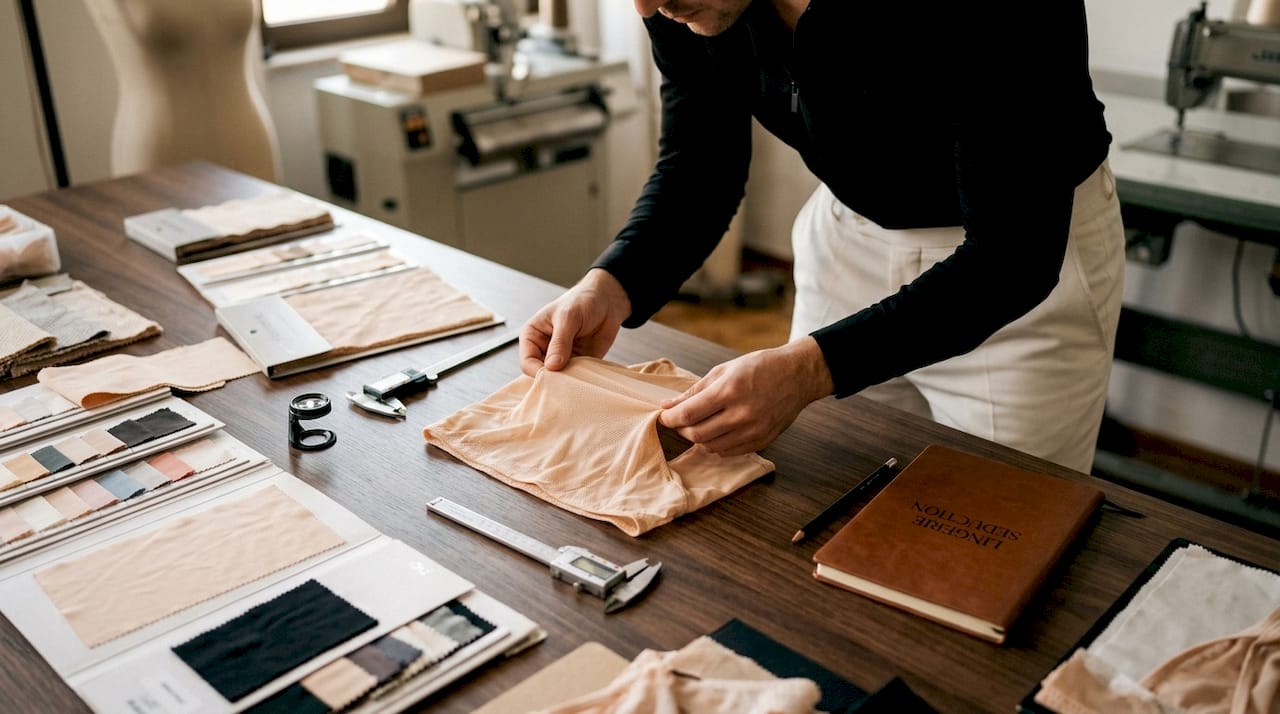
Lingerie fabric construction affects how a garment performs over time, not just how it looks on a hanger. Knit structures stretch in multiple directions and are used for cups and bands; woven lace is more structured but less forgiving. The lace substrate matters too: a Raschel lace (machine-knitted) is more durable and consistent than a Chantilly lace (woven), which is finer and more prone to snagging.
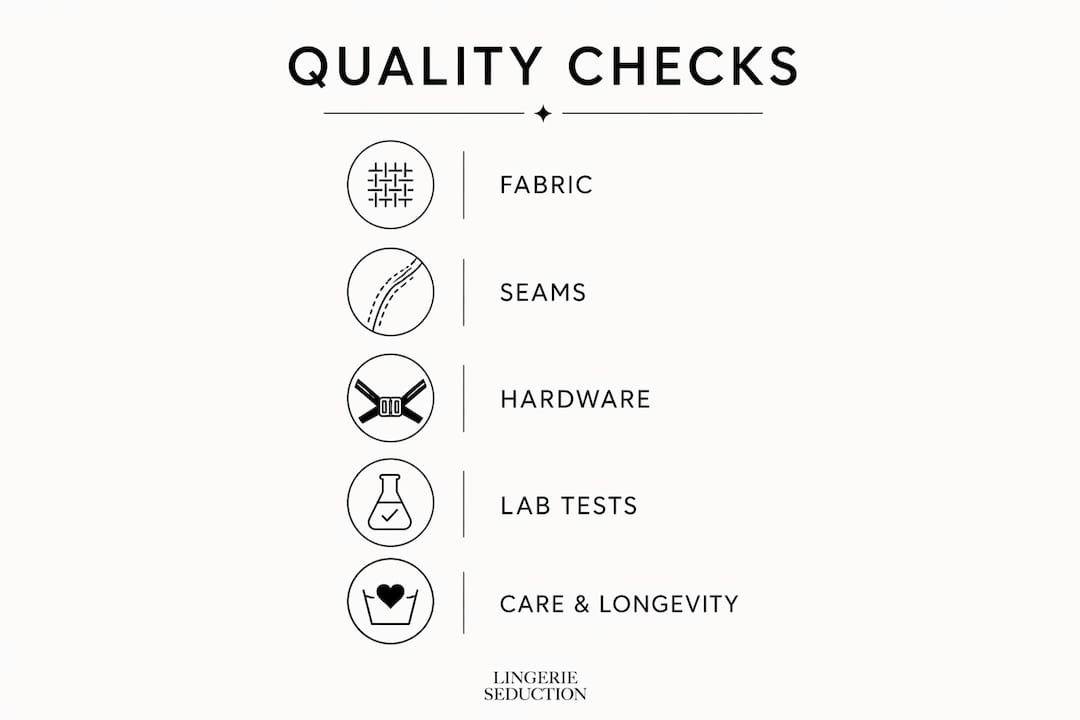
The stretch-and-release test is the most practical fabric check available without a lab. Stretch the fabric gently to about twice its resting width and release. High-quality fabric returns immediately without creasing. Slow recovery, permanent elongation, or visible distortion after release all predict early loss of fit. This matters most for bands and cups, where poor recovery leads to band roll and strap creep.
For lace specifically, soft-handle lace plus a satin or microfibre lining is the standard for long-term comfort. Unlined delicate lace causes irritation and wears faster. Run a finger across the lace surface: it should feel smooth and even, with no rough yarn ends or stiff patches. The Luxury Black Sheer Lace Lingerie Set uses this principle, pairing sheer lace with a lining layer that sits against the skin.
Data table: common lingerie fibres and their properties
| Fibre | Breathability | Abrasion resistance | Dye stability | Best use | Common failure mode |
|---|---|---|---|---|---|
| Polyamide (nylon) | Moderate | High | High | Bras, sheer lace, hosiery | Pilling at friction points |
| Polyester | Low | High | High | Briefs, everyday bras | Heat retention, less soft |
| Modal | High | Moderate | Moderate | Briefs, sleep pieces | Lower elasticity |
| Cotton | High | Moderate | Moderate | Briefs, linings | Shrinkage, lower stretch |
| Silk | High | Low | Moderate | Luxury pieces | Snagging, abrasion |
| Elastane blend | N/A | Moderate | High | All structured pieces | Permanent elongation over time |
Pro Tip: For higher-risk purchases (premium bras, bridal sets), request the supplier’s elastane specification sheet. Key figures to ask for: denier, elongation at break, and heat-set retention results. A robust elastic should show no more than 8% permanent elongation loss after a 90°C heat-set test.
How do stitching, seams, and hardware reveal build quality?
Stitching quality is one of the clearest objective indicators of how long a garment will last. Lingerie seams commonly target a moderate number of stitches per inch; fewer stitches produce weaker, more open seams that are prone to unravelling under repeated stress. Count stitches on a 2.5 cm section of seam if you have a ruler handy. Consistent spacing and even thread tension are what you are looking for; skipped stitches or puckered thread are immediate red flags.
Seam types and where they belong:
- Lockstitch: used for structural seams (side seams, underwire casings); strong and clean on both sides
- Overlock (serger): used for finishing raw edges; prevents fraying but is not a structural stitch on its own
- Flatlock: used where seams sit against skin (inner thigh, underband); lies flat and reduces irritation
- Bar tack: a reinforcing stitch cluster at high-stress points (strap anchors, hook-and-eye attachment); its presence indicates manufacturing care
Seam strength benchmark: Bra side seams should withstand a substantial force before failing. At that threshold, the seam holds through normal movement, washing, and the stress of putting on and removing the garment. Below that figure, side seams are likely to fail within months of regular wear.
To test seam integrity without equipment, grip the fabric on both sides of a seam and apply firm, steady tension. The seam should not shift, gap, or show thread movement. Check for skipped stitches by holding the seam up to light. Also run a finger along the underwire channel: the casing should be fully enclosed with no wire tip protruding or pressing through the fabric.
Hardware checks are quick and decisive. Metal hardware (rings, sliders, hooks) should feel solid and have a smooth, even finish with no sharp edges or flaking plating. Plastic hardware is acceptable for lighter garments but should not flex or crack under light pressure. Hook-and-eye sets should fasten with a clean click and release without snagging. Nickel release is a skin safety concern; if hardware is not labelled as nickel-free, request an EN 1811 nickel release test result for any piece worn close to skin.
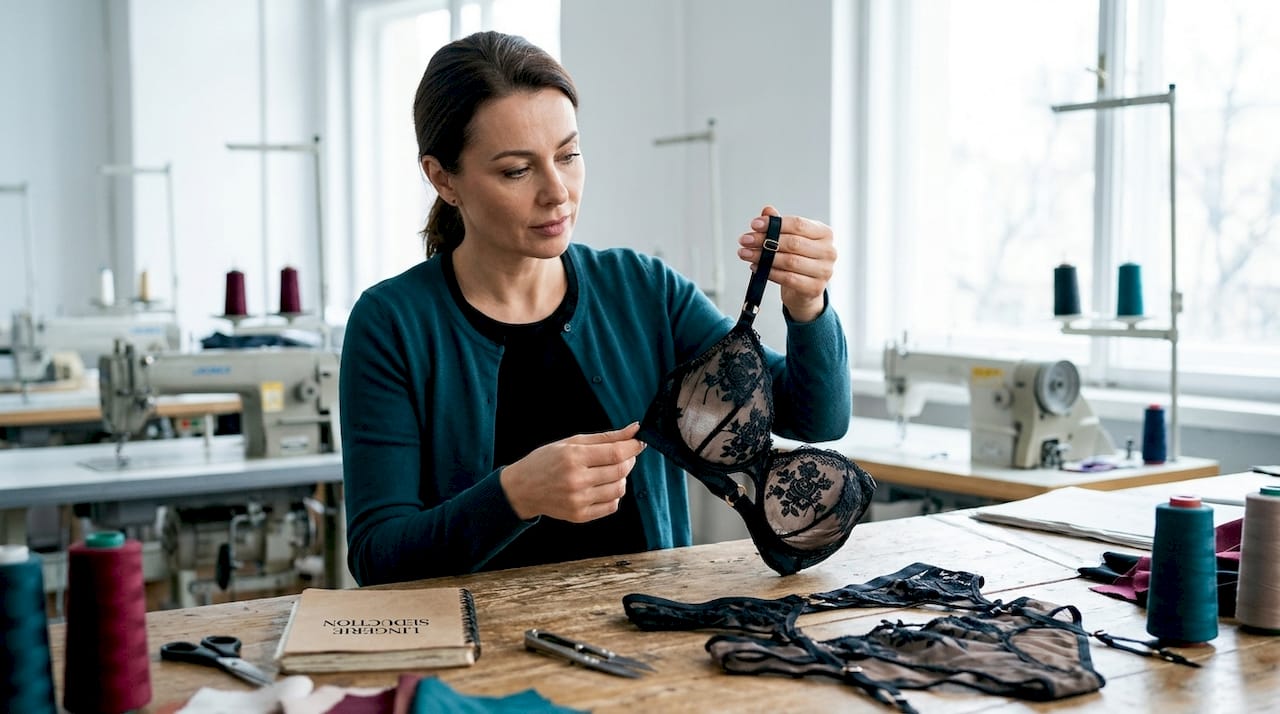
Pro Tip: In store, test the strap slider by moving it through its full range while applying light tension to the strap. A quality slider grips at every position and does not creep back. A slider that slides freely under tension will not hold adjustment during wear.
What do production inspections and lab tests actually check?
Quality control in lingerie manufacturing runs across three stages, each catching different failure types. Understanding these stages helps you know what questions to ask and what documents to request.
The three production inspection stages:
- Pre-production / raw material inspection: Fabric, lace, elastics, and hardware are checked before cutting begins. This stage verifies that fibre content matches declarations, colour is consistent across rolls, and elastics meet elongation and retention specs. Fabric defects (holes, weave errors, shade variation) are identified here, not after cutting.
- In-line / DUPRO inspection: Checks are conducted mid-production, typically after 10–20% of units are complete. Inspectors verify stitching, seam construction, sizing, and assembly against approved samples. This is where SPI counts, seam alignment, and hardware attachment are confirmed.
- Final pre-shipment inspection: Conducted on finished, packed goods before shipment. A 10-point final inspection checklist covers fabric, colour consistency, stitching, measurements, hardware, and packaging. Sample sizes are determined by Acceptable Quality Limit (AQL) standards, which define how many pieces to inspect from a production lot and the defect thresholds for acceptance or rejection.
Core laboratory tests and what they measure:
| Test | Standard | What it measures | Consumer meaning |
|---|---|---|---|
| Tensile / burst strength | ISO 13934 | Force required to break fabric | Will the strap anchor hold under load? |
| Seam strength (seam pull) | ASTM D1683 | Force required to separate a seam | Does the side seam hold through wear and washing? |
| Pilling resistance | ISO 12945-1 | Surface fibre balling after abrasion | Will the fabric look worn after a few washes? |
| Colourfastness to washing | ISO 105-C06 | Colour retention after repeated washing | Will the colour bleed or fade? |
| Colourfastness to perspiration | ISO 105-E04 | Colour stability under sweat conditions | Safe for all-day wear? |
| Shrinkage | — | Dimensional change after washing | Will it still fit after the first wash? |
| Nickel release | EN 1811 | Nickel migration from hardware | Safe for skin contact? |
When evaluating a supplier or a premium purchase, request the full test dossier: lab reports with a visible lab stamp, test dates within the past 90 days, and sample IDs that match the production batch. A report without a sample ID or with a date older than 90 days is not reliable for the current production run.
Pro Tip: Ask suppliers for seam pull test videos, not just static lab sheets. A video shows whether the seam fails by thread unravelling (poor stitch formation) or fabric tear (strong stitch, weaker base fabric). Fabric tear at the seam is actually the preferred failure mode: it means the stitching held.
Which standards and labels matter for Australian shoppers?
In Australia, textile labelling is governed by the Trade Practices (Consumer Product Information Standards) (Textile Products) Regulations 1987, which require garments sold in Australia to carry a fibre content label and care instructions. Country of origin labelling is also required under the Australian Consumer Law for most clothing. These are not optional: a garment without a care label or with a vague fibre description (e.g. “lace” with no fibre percentage) does not meet Australian retail standards.
What a compliant label includes:
- Fibre content by percentage (e.g. 80% polyamide, 20% elastane), listed for each component where they differ
- Care instructions using standardised care symbols or written instructions
- Country of manufacture
- Supplier or importer name and contact details for Australian market goods
Standards Australia references ISO textile test methods for most performance testing. The ISO standards most relevant to lingerie are ISO 13934 (tensile), ISO 12945 (pilling), ISO 105-C06 (colourfastness to washing), and ISO 105-E04 (colourfastness to perspiration). EN 1811 (nickel release) is a European standard but is widely used in Australian import testing because it is the most recognised method for hardware safety.
Label verification checks:
- Compare the declared fibre content against the hand-feel and stretch behaviour; a garment labelled 80% polyamide should feel smooth and recover quickly
- Request a recent lab test report that confirms the declared fibre percentages via spectrometry or burn testing
- Run a simple wash trial (three cycles on delicate) and compare results against the care label claims before approving a bulk order or making a high-value purchase
- Check hardware for a nickel-free marking or request an EN 1811 test result
Export compliance failures illustrate why this matters. Common rejection reasons include incorrect fibre content labelling and excessive nickel in hardware. Both are preventable with basic label verification and a nickel release test result.
Care label accuracy: Industry audits found that a significant proportion of sampled care labels contained at least one invalid instruction. Running three wash-and-dry cycles on five units before approving labels is standard practice for buyers who want to verify care claims before committing to stock.
Pro Tip: A valid lab report carries the testing laboratory’s stamp or accreditation number, the test date, the sample description, and the specific standard used. If any of these elements are missing, the report cannot be verified and should not be accepted as proof of compliance.
How to check quality in store and online: checklist and red flags
Five-step inspection process:
- Inspect fabric and lining up close. Look for even colour, consistent texture, and no loose threads or surface defects. For lace, check that the pattern is regular and the lining (if present) is smooth and fully attached.
- Test strap adjuster and hook action. Move the adjuster through its full range; fasten and unfasten the hooks. Both should operate smoothly with no catching or slipping.
- Cup recovery test. Press the cup gently and release. Immediate return to shape indicates good foam or fabric memory; slow recovery or permanent distortion is a quality concern.
- Check seams and reinforcement points. Pull gently on side seams and strap anchors. Look for bar tacks at high-stress points. Hold seams to light to check for skipped stitches.
- Verify the label. Confirm fibre percentages are listed, care instructions are present, and country of origin is stated. For premium purchases, ask for a lab test report.
Red flags to reject on sight:
- Mismatched thread colour or uneven thread tension along a seam
- Shiny, brittle, or stiff elastics (a sign of industrial-grade rather than garment-grade elastane)
- Exposed or protruding underwire tips through the casing fabric
- Strap adjusters that slide freely under light tension
- Fibre content labels that list only “lace” or “fabric” without percentages
- Care labels with contradictory instructions (e.g. “machine wash” and “do not wash”)
Shopping online: Request close-up photos of seams, hardware, the wash label, and the product underside before purchasing. For higher-value orders, ask for recent lab test scans. Expert tips on what to look for when shopping for lingerie online cover fit and fabric checks that apply equally to quality assessment.
Three questions to ask any seller:
- “Can you provide the fibre content breakdown for each component?”
- “Do you have a recent lab test report for seam strength and colourfastness?”
- “What is the SPI count on the main structural seams?”
Pro Tip: When evaluating swimwear or lingerie with similar construction, the same seam and fabric checks apply. Guidance on spotting quality construction in close-fitting apparel translates directly to lingerie inspection.
How long should lingerie last, and how do you care for it?
Realistic lifespan depends on fibre type, construction quality, frequency of wear, and care habits. A daily microfibre bra, worn and washed regularly, typically lasts 1–3 years with proper care. Delicate lace pieces, particularly unlined styles, have a shorter functional life of 1–2 years under regular use, though occasional-wear pieces last considerably longer. Structured bras with underwires tend to fail at the wire channel or hook-and-eye before the fabric shows wear.
Care checklist:
- Wash on a delicate cycle or by hand using a mesh laundry bag; machine washing without a bag causes strap tangling and hardware damage
- Use a gentle detergent formulated for delicates; avoid biological detergents that break down elastane
- Dry flat, away from direct heat and sunlight; heat degrades elastane and causes permanent elongation
- Store bras flat or hanging, not folded cup-into-cup; folding distorts the cup shape over time
- Rotate between at least two bras daily to allow elastic recovery between wears
Repair guidance: Reinforcing a loose strap anchor with a bar tack (a small cluster of tight stitches) extends garment life significantly. Restitching a seam allowance that has begun to unravel is straightforward with a basic sewing machine or by hand. Hook-and-eye sets can be replaced with standard haberdashery replacements. Underwire channels that have worn through can be relined with a strip of casing tape, available from fabric retailers.
For everyday lingerie worn frequently, repair is worth attempting when the fabric and cups are still in good condition but a single component (strap, hook, wire) has failed. Replace rather than repair when the elastic has permanently stretched, the lace is snagged across multiple areas, or the underwire has broken through the casing in a way that cannot be safely relined.
Pro Tip: The decision rule is simple: if the fabric still passes the stretch-and-release test and the cups hold their shape, repair the hardware. If the fabric fails the recovery test, replace the garment.
What Lingerie Seduction’s team focuses on when selecting products
Lingerie Seduction’s product selection process starts with fabric and construction, not aesthetics. When the team evaluated the Luxury Black Sheer Lace Lingerie Set, the key criteria were lace softness (no scratchy yarn ends), lining quality (smooth microfibre against skin), and seam finishing at the underwire channel. The European White Sheer Lace Lingerie Set was selected with bridal and special-occasion buyers in mind: the fabric needed to hold its shape under a dress, resist perspiration staining, and photograph cleanly, which required confirmed colourfastness results.
For fit technicians, the practical checks are specific. Bar tacks at strap anchors are non-negotiable for any bra with a heavier cup. Bands with three or more hook-and-eye columns are preferred for sizes above a 14 band, because the load is distributed across more attachment points. Underwire ends must be fully enclosed with no tip movement detectable through the casing.
Lingerie Seduction verifies suppliers by requesting graded pattern specifications, seam pull test videos, and full test dossiers dated within 90 days of the production run. Static lab sheets are not accepted without a matching sample ID. Suppliers who cannot provide seam pull videos are not approved for structured bra production.
Fit technicians also check the benefits of lace construction against the specific use case: a lace piece intended for daily wear needs a full lining, while an occasional-wear piece may carry a partial lining if the lace substrate is soft-handle grade.
Pro Tip: When reviewing a new supplier’s sample, request a seam pull video alongside the static test report. The video reveals stitch behaviour under load that a number alone cannot show.
Suggested blog tags for this article: fabric quality, care guide, product testing, lingerie buying guide, lace lingerie, construction quality, quality indicators
How to prioritise quality indicators based on your needs
Not every quality indicator carries equal weight for every purchase. The right priority depends on how and how often you plan to wear the piece.
For everyday comfort and durability:
- Prioritise elastic recovery and band construction above all else; a band that loses tension within weeks is the most common daily-wear failure
- Check SPI on side seams and strap anchors; 12–14 SPI is the target
- Verify fibre content includes a polyamide or modal base with 15–20% elastane
- Confirm the care label supports machine washing on delicate
For special-occasion and aesthetic pieces:
- Prioritise fabric hand-feel and lace softness; the piece will be worn against bare skin for extended periods
- Confirm colourfastness results, particularly for white or pale pieces where perspiration staining is a risk
- Check that underwire ends are fully enclosed and hardware is smooth; comfort matters even for occasional wear
- The European White Sheer Lace Lingerie Set is a practical reference for what bridal-quality finishing looks like
For budget purchases where value matters:
- Focus on the three checks that cost nothing: hand-feel, strap adjuster action, and seam pull
- Accept lower guarantees on lab test documentation, but do not accept missing fibre content labels
- Avoid pieces with exposed underwire tips or brittle elastics regardless of price
Lab-tested items are worth the investment for daily essentials. For fashion pieces worn occasionally, the in-store checks above are sufficient. The single most reliable summary: fabric recovery, seam strength, and hardware quality predict longevity; everything else is secondary.
Key takeaways
Quality lingerie is identified by three objective indicators: fabric stretch recovery, seam strength at or above 120 N for structural seams, and hardware that operates smoothly with verified nickel-free status.
| Point | Details |
|---|---|
| Fabric recovery is the primary test | Stretch and release: fabric should return immediately with no creasing or permanent elongation. |
| SPI and seam strength matter | Target 12–14 SPI on structural seams; bra side seams should hold at least 120 N of force. |
| Hardware quality is a safety check | Metal hardware should be smooth, plated evenly, and nickel-free or supported by an EN 1811 test result. |
| Lab reports confirm what touch cannot | Request test dossiers with a lab stamp, date within 90 days, and sample ID for premium purchases. |
| Lingerie Seduction applies these checks | Products like the Luxury Black Sheer Lace Lingerie Set are selected against fabric, construction, and test criteria before listing. |
Why these indicators matter to Lingerie Seduction
Lingerie Seduction selects every product against the same criteria covered in this article: fabric recovery, seam construction, hardware quality, and supplier test documentation. The brand’s position is that quality is not a marketing claim; it is a set of measurable, testable properties that either pass or do not.
The difference between cheap and luxury lingerie is not always visible at first glance, which is why construction checks and lab results matter more than price alone. Lingerie Seduction’s supplier vetting process requires seam pull test videos and full test dossiers dated within 90 days. Pieces that do not meet the soft-handle lace standard or the underwire casing requirement are not listed, regardless of aesthetics.
Publishing checklist: Before publishing this article, add the following blog tags in the site CMS: fabric quality, care guide, product testing, lingerie buying guide, lace lingerie, construction quality, quality indicators.
Useful sources and further reading
The following sources and internal pages support the claims in this article and provide further detail for readers who want to go deeper.
External standards and testing references:
- ISO 13934: Tensile properties of fabrics; the standard used to measure strap and fabric breaking strength
- ISO 12945-1: Pilling resistance; used to predict surface wear after repeated washing
- ISO 105-C06: Colourfastness to domestic and commercial laundering
- EN 1811: Nickel release from hardware in contact with skin
- ASTM D1683: Seam strength by seam pull test
Internal Lingerie Seduction pages:
| Page | Relevance |
|---|---|
| How lingerie fabrics are made | Technical background on fibre types and knit structures |
| Benefits of lace lingerie | Comfort and construction factors for lace pieces |
| Cheap vs luxury lingerie | Price tier differences and what they mean for quality |
| Top fabrics in lingerie | Overview of fabric choices across the range |
| Lace lingerie styles explained | Style and construction examples for lace pieces |
Quality lingerie, without the guesswork
Knowing what to check is one thing. Finding pieces that already pass those checks is another. Lingerie Seduction stocks a curated range of premium lingerie selected against the fabric, construction, and finishing criteria covered in this article. Every piece in the range has been assessed for lace softness, seam quality, and hardware finish before listing.
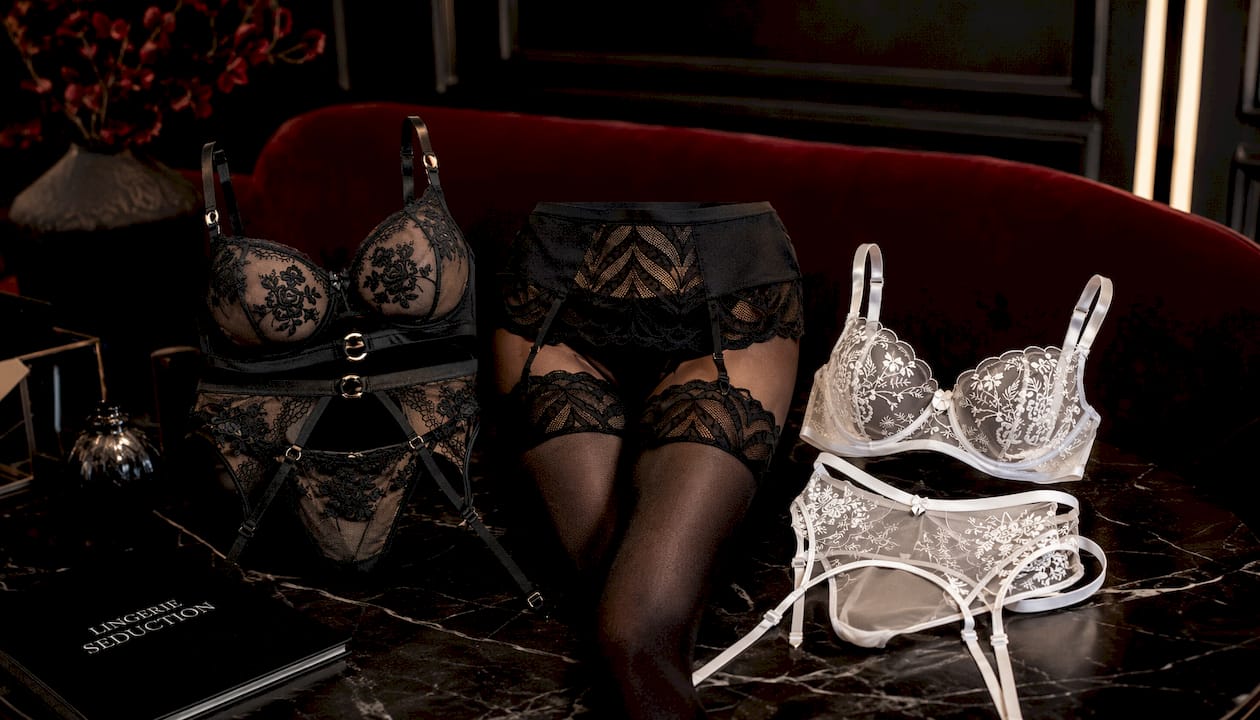
The Luxury Black Sheer Lace Lingerie Set and Luxury Black Sheer Lace Top Stockings are practical starting points for shoppers who want lined lace construction and clean hardware finishing without sourcing and vetting suppliers themselves. Free shipping applies to orders over $100, and hassle-free returns mean you can apply the stretch-and-recovery test at home with no risk. Browse the full range at Lingerie Seduction and use the checklist in this article to confirm quality on arrival.
FAQ
How do you tell if lingerie is high quality?
Check three things: fabric stretch recovery (release after stretching should be immediate), seam strength (a firm pull on side seams should show no movement or thread shift), and hardware action (adjusters grip, hooks fasten cleanly). Fibre content labels specifying percentages and a care label with valid instructions are also reliable indicators of manufacturing care.
What stitches per inch should quality lingerie have?
Quality lingerie targets 12–14 stitches per inch (SPI) on structural seams. Fewer stitches produce weaker seams that unravel faster under repeated stress and washing.
What makes lace lingerie comfortable long-term?
A soft-handle lace finish combined with a satin or microfibre lining is the standard for comfort. Unlined lace sits directly against skin and causes irritation over time, particularly at seam edges.
What lab tests should I ask for when buying premium lingerie?
Request colourfastness (ISO 105-C06), seam strength (ASTM D1683), and pilling resistance (ISO 12945-1) results as a minimum. For hardware, ask for an EN 1811 nickel release result. All reports should carry a lab stamp, a test date within 90 days, and a sample ID matching the production batch.
How long should a quality bra last?
A daily microfibre bra with proper care typically lasts several years. Delicate lace pieces used regularly have a shorter functional life but can last well with proper care. Lifespan extends significantly with hand washing or delicate-cycle machine washing in a mesh bag, flat drying away from heat, and rotating between multiple pieces.


