


Wash silk lingerie: safe hand-wash steps and machine fallback
You can wash silk lingerie at home. Hand washing is the safest method, and machine washing works only as a protected fallback. Silk is a protein fibre that weakens when wet and reacts badly to alkaline detergents, so the way you wash it matters more than whether you wash it.
Here’s your quick reference before you start:
- Check the care label first — “dry clean only” or a running dye test means skip the home wash.
- Water temperature: cool to lukewarm, always under 30°C.
- Detergent: pH-neutral, enzyme-free only — biological detergents can damage protein fibres.
- No shortcuts: no bleach, no wringing, no tumble drying, ever.
Pro Tip: Wash silk lingerie less often than you think you need to — several wears between washes is usually enough unless there’s visible soil or odour.
Table of Contents
- How to check the care label and test for colourfastness
- How do you sort and pre-treat stains before washing?
- How do you hand-wash silk lingerie step by step?
- Can you machine wash silk lingerie safely?
- How do you dry and reshape silk lingerie without damage?
- How often should you wash silk lingerie and how should you store it?
- What are common silk washing problems and how do you fix them?
- When should you choose professional dry-cleaning instead?
- What detergents and tools work best for silk in Australia?
- What does Lingerie Seduction recommend for silk care?
- Give your silk lingerie the care routine that keeps it wearable
- Find your next piece with confidence at Lingerie Seduction
- Sources
- FAQ
How to check the care label and test for colourfastness
Every silk garment carries a story in its care label, and it’s worth reading before you fill the basin. A hand-wash symbol (a hand in a tub) usually clears you for home washing, while a circle means dry clean only. Temperature dots on the label tell you the maximum safe water heat, and a crossed-out iron or tumble dryer symbol means exactly what it says.
Before washing anything, test for colourfastness. Dab a damp white cloth on an inconspicuous seam or hem and check whether dye transfers onto the cloth.
- No transfer: proceed with hand washing.
- Dye transfers or bleeds: stop and take the piece to a professional cleaner instead.
- Label says “dry clean only”: don’t attempt a home wash at all, even if colourfastness looks fine.
Deep or vintage dyes are the most likely to run, so checking colourfastness is worth the extra two minutes every single time.
How do you sort and pre-treat stains before washing?
Separate silk from everything else, then separate silk from silk. Thin, sheer pieces need gentler handling than lined or structured garments with boning or padding, and dark colours should never share water with pale ones.
Pre-treat stains before the full wash so you don’t set them deeper into the fibre:
- Blot (never rub) protein stains like sweat or makeup with cold water on a clean cloth.
- Lift oil-based marks by sprinkling cornstarch or talc on the stain, letting it sit, then brushing it off gently before washing.
- Treat wine or fruit stains with a dab of diluted white vinegar, tested on a hidden area first.
Pro Tip: Always wash the entire garment after spot-treating, not just the stained patch — treating one small area alone is how you end up with a visible tide line.
How do you hand-wash silk lingerie step by step?
Hand washing gives you full control over temperature, chemistry and friction, which is exactly what silk needs. Use a dedicated clean basin rather than the kitchen sink, since mineral deposits and leftover residue from other tasks can transfer onto the fabric.
- Fill the basin with cool water under 30°C and fully dissolve a small amount of pH-neutral, enzyme-free detergent before adding the garment.
- Submerge the piece and swish it gently through the water, the same slow motion as kelp moving in the ocean, never scrubbing or twisting.
- Soak for no more than three to five minutes. Wet silk loses tensile strength the longer it sits, and longer soaks also risk dye migration.
- Rinse in fresh cool water until it runs completely clear. A final rinse with a capful of white vinegar in the water can help restore shine and remove detergent residue.
- Lay the garment flat on a clean white towel, roll it up, and press gently to draw out water. Never wring.
- Unroll and reshape the piece by hand while it’s still damp, easing straps and cups back into their natural form.
Handle delicate trims, underwires and adjustable straps with extra care during swishing. They’re where seams pull first under any tension.
- Don’t use hot water, ever.
- Don’t scrub, twist or wring.
- Don’t leave it soaking longer than five minutes.
Pro Tip: If you’re washing a set, do the bra and briefs separately so hooks and clasps don’t snag delicate mesh or lace.
Can you machine wash silk lingerie safely?
Reserve the machine for sturdier, everyday silk pieces like camisoles or simple slips, never for anything structured, boned or heavily beaded. If you’re washing something like a sleepwear set with a simple flat construction, the machine can work as an occasional fallback when hand washing isn’t practical.
Wet silk is significantly weaker than dry silk, and the friction inside a washing machine drum, even on a gentle cycle, adds real risk of pilling, snags and seam stress. Machine washing remains an acceptable option only when every protective step below is followed.
| Setting | Recommendation |
|---|---|
| Bag | Fine-mesh laundry bag or clean pillowcase, garment fully enclosed |
| Wash partners | Similar delicates only, no zips or heavy fabrics |
| Water temperature | Cold, under 30°C |
| Cycle | Delicate or hand-wash setting |
| Spin | Lowest available, or skip spin entirely |
| Detergent | Minimal amount, pH-neutral, no fabric softener |
How do you dry and reshape silk lingerie without damage?
Once you’ve done the towel roll to remove excess moisture, resist the urge to twist the garment again for extra water. Lay flimsy pieces flat on a fresh dry towel; hang structured pieces like bralettes on a padded hanger so the shoulder shape holds while damp.
Reshape by hand as it dries. Ease cups, straps and hems back into position now, because silk sets into whatever shape it dries in.
- Never use a tumble dryer, on any setting.
- Keep the piece out of direct sunlight, which fades and weakens the fibre.
- Keep it away from radiators, heaters and other direct heat sources.
- If wrinkles remain once dry, steam lightly from a distance or iron on the reverse side using the lowest heat setting.
Pro Tip: If silk feels stiff once dry, a light misting of water followed by a very brief low-heat steam often restores softness better than any fabric conditioner.
How often should you wash silk lingerie and how should you store it?
Less is more with silk. Most pieces only need washing every three to six wears unless there’s visible soil, and spot-cleaning a small mark between washes is gentler than a full wash you didn’t need to do.
Storage protects just as much as washing technique does:
- Use breathable cotton or muslin pouches, never sealed plastic bags.
- Fold soft, unstructured pieces; hang boned or padded pieces like a corset on a padded hanger.
- For long-term storage, wrap in acid-free tissue paper.
- Store away from direct sunlight and check periodically for moths, especially over the warmer months when they’re most active.
What are common silk washing problems and how do you fix them?
Even careful washing occasionally goes sideways, and most issues have a straightforward fix if you catch them early.
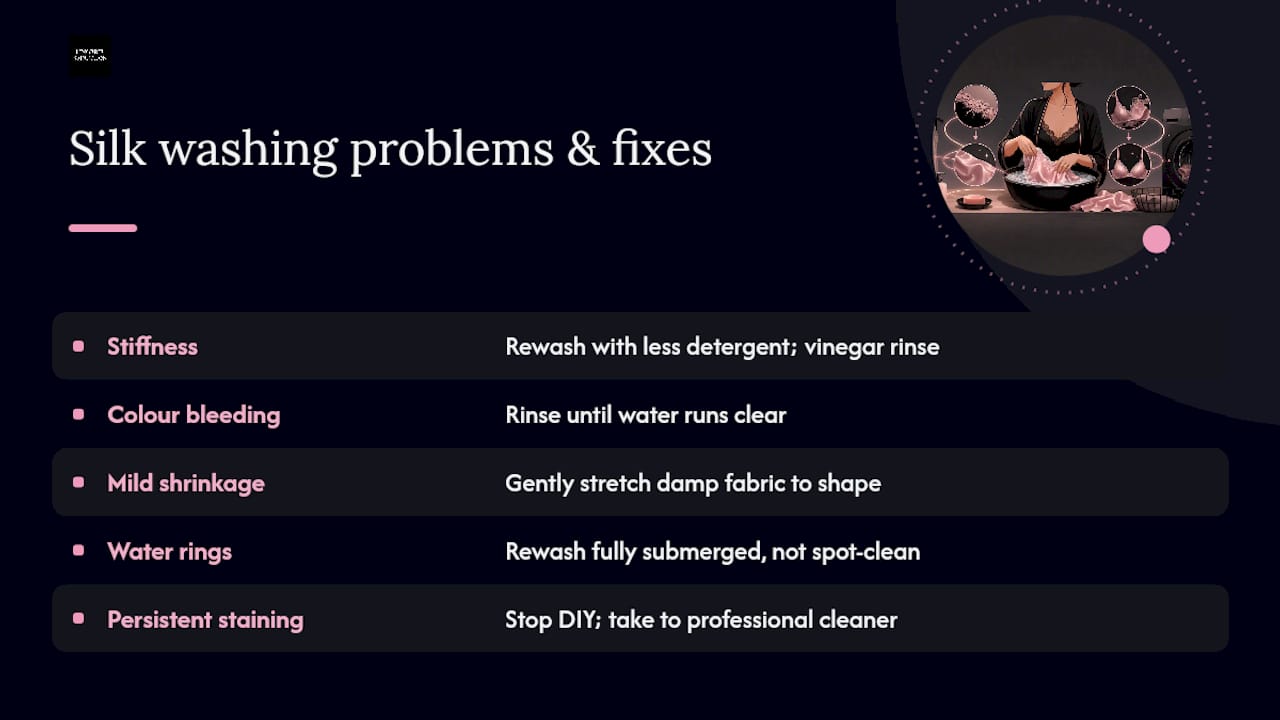
Stiffness after washing usually means detergent residue. Rewash with less product and a proper vinegar rinse to strip it out. Colour bleeding during the wash means you rinse until the water runs completely clear; if the colour keeps releasing, stop and consult a professional cleaner rather than risk the whole garment. Mild shrinkage can sometimes be eased by gently stretching the damp fabric back to shape by hand, though it won’t reverse serious shrinkage from hot water. Water rings or tide lines typically mean the garment dried unevenly. A full rewash, this time submerging the entire piece rather than spot-cleaning, generally clears them.
Persistent staining, visible structural damage or dye loss that doesn’t stop with rinsing are all signs to stop DIY attempts and call in a professional.
When should you choose professional dry-cleaning instead?
Some silk pieces are better left to a professional from the outset, and knowing which ones saves you a ruined garment.
- The care label reads “dry clean only,” full stop.
- The piece is heavily beaded, boned or otherwise structurally complex, like a corset lingerie set.
- The dye is vintage or unusually saturated and failed your colourfastness test.
- A stain didn’t lift after a careful spot treatment attempt.
When you drop it off, tell the cleaner exactly what you tried, where the stain sits, and the fibre content if you know it. That detail helps them choose the right solvent and avoid repeating a method that already failed.
What detergents and tools work best for silk in Australia?
You don’t need a specialist cabinet full of products, just the right handful of basics.
- A pH-neutral, enzyme-free wool and silk wash, widely available at supermarkets and department stores.
- A dedicated plastic or ceramic basin kept separate from dishwashing or cleaning use.
- Fine-mesh laundry bags for the occasional machine-wash fallback.
- Plain white cotton towels for the roll-and-blot drying method.
- A padded hanger for structured pieces and a handheld garment steamer or iron for reverse-side touch-ups.
Pro Tip: Buy a travel or sample size of a new detergent first and test it on an inconspicuous seam before committing a full bottle to your favourite pieces.
What does Lingerie Seduction recommend for silk care?
Construction dictates the method every time. A simple, unlined babydoll or camisole can usually handle an occasional protected machine wash, while boned, beaded or heavily trimmed pieces should always be hand-washed or professionally cleaned.
If you’re ever unsure about a specific piece, our customer service team can talk you through care based on construction, and returns are hassle-free if something doesn’t fit as expected. Orders over $100 ship free.
- Hand wash: sheer, beaded or boned pieces.
- Fallback machine wash: simple, unlined everyday silk.
- Always inspect seams, trims and embellishments before washing to catch loose threads or weak stitching early.
Pro Tip: A quick seam check before every wash catches small snags before they become a torn strap mid-cycle.
A note from Lingerie Seduction
We design pieces to be worn and enjoyed, not stored away out of fear. Treating silk with a little patience, cool water and the right detergent means the lingerie you love keeps its shape, colour and feel wear after wear. That’s the balance we build into every recommendation we make.
Give your silk lingerie the care routine that keeps it wearable
Silk lingerie rewards patience: hand wash where possible, protect it strictly when you must use the machine, and store it properly between wears to get years out of pieces most people write off after a season.
| Point | Details |
|---|---|
| Default to hand washing | Cool water under 30°C, pH-neutral enzyme-free detergent, soak no longer than five minutes. |
| Machine wash only as fallback | Mesh bag, cold delicate cycle, lowest spin, and only for sturdy unstructured pieces. |
| Never use heat or agitation | Skip hot water, wringing, tumble drying, and fabric softener entirely. |
| Wash less, store smarter | Three to six wears between washes, breathable pouches, padded hangers for structured pieces. |
| Choose Lingerie Seduction for the right piece | Lingerie Seduction stocks both simple silks suited to protected machine washing and structured styles best kept for hand washing or professional care. |
Find your next piece with confidence at Lingerie Seduction
Lingerie Seduction gives you what a generic laundry guide can’t: garments built with your care routine in mind, and honest advice about which construction suits hand washing versus a protected machine cycle. Every piece in our range, from simple sleepwear to structured statement sets, is chosen with real-world wear and care in mind, not just how it photographs.

If you’re after something low-maintenance for everyday wear, our sleepwear sets handle a protected machine wash without drama. Want something more special? Our sheer mesh and lace babydoll and bridal sleepwear are built for hand washing, so they hold their shape and shine for the occasions that matter most. Free shipping applies on orders over $100, and returns are hassle-free if the fit isn’t quite right. Browse the current range and pick your next piece with a care plan already sorted.
Sources
- How to wash silk in the washing machine or by hand | Persil
- Washing Silk at Home: The Chemistry of Protein Lustre and pH
- How to Wash Underwear, Silk, and Lace: The Gentle Guide to Caring for Your Delicates | Dirty Labs
This guide draws on both retailer experience and external textile-care research.
FAQ
Can you put 100% silk in the washing machine?
Yes, but only sturdier, unstructured pieces on a cold delicate cycle inside a fine-mesh bag. Boned, beaded or heavily embellished silk should always be hand-washed or professionally cleaned.
Does silk shrink if you wash it?
Silk can shrink if washed in hot water or dried with heat, but washing in cool water under 30°C and air-drying flat avoids this in most cases.
How can I make silk soft again after washing?
A light steam from a distance or a rinse with a splash of white vinegar usually restores softness better than a fabric conditioner, which can leave residue on the fibre.
How often should I wash my silk lingerie?
Every three to six wears is typical unless there’s visible soil, sweat or odour, since washing less often reduces the mechanical and chemical stress on the fibre over time.
What detergent is best for silk lingerie?
A pH-neutral, enzyme-free detergent made for silk or wool is safest, since biological detergents contain protease enzymes that can chemically weaken protein fibres.
Recommended
- How to Wash Lingerie Properly | Keep Premium Lingerie New – Lingerie Seduction
- How to Properly Wash Lace Lingerie: The Aussie Care Guide for 2026 – Lingerie Seduction
- How to Properly Wash Lace Lingerie: The Ultimate Aussie Care Guide for – Lingerie Seduction
- Lingerie care best practices for lasting fit – Lingerie Seduction


