

Lingerie care best practices for lasting fit
Proper lingerie care preserves fit, support and fabric — and follows a few simple, repeatable rules. Hand-wash when possible, use cool water, skip the tumble dryer, and reshape cups before drying. Follow these and your pieces will last significantly longer.
Quick dos and don’ts:
- Do hand-wash in cool or lukewarm water with a mild, enzyme-free detergent
- Do fasten hooks before washing to prevent snags
- Do air-dry flat or draped over a towel, away from direct sunlight
- Do reshape moulded cups immediately after washing
- Do rotate at least three bras to reduce wear frequency
- Don’t tumble dry — ever
- Don’t wring or twist to remove water
- Don’t use chlorine bleach or heavy fabric softeners
- Don’t wash in hot water
- Don’t hang bras by one strap to dry
TL;DR: Cool water + mild detergent + air-dry = lingerie that holds its shape and support for far longer. One habit change makes the biggest difference: ditch the tumble dryer.
Pro Tip: Pre-dissolve your detergent in the water before adding the garment. Undissolved detergent concentrate sitting directly on elastane can weaken fibres over time.
Table of Contents
- Why does poor care shorten fit and support life?
- How do you hand-wash delicate lingerie correctly?
- When is machine washing safe, and how do you set it up?
- What detergents and products should you use?
- How should you dry bras, lace and other delicate items?
- How should you store lingerie to protect cup shape and fabric?
- What care does each fabric type need?
- How do you remove stains from delicate lingerie safely?
- How often should you wash lingerie?
- What do care labels in Australia mean, and why do they matter?
- What are the most common care mistakes that shorten lingerie life?
- Key takeaways
- The case for slowing down your wash routine
- Lingerie Seduction: quality pieces built to last
- Useful sources and references
- FAQ
Why does poor care shorten fit and support life?
Heat and mechanical stress are the two fastest ways to ruin lingerie. Hot water and tumble dryers degrade elastane and spandex fibres, permanently reducing stretch and shape retention. Rough machine cycles cause fabric abrasion, seam stress and dye bleed. The result is a garment that looks and feels worn out well before its time.
Concrete consequences of poor care:
- Misshapen or collapsed moulded cups
- Loss of elastic stretch in bands and straps
- Colour fading and dye transfer, especially on dark or bright pieces
- Seam and lace trim failure from friction
- Underwire migration caused by weakened casing fabric
Australia’s Consumer Goods (Care Labelling) Information Standard 2023 makes care labels mandatory on most new textile products precisely because following them protects both the garment and the consumer. Ignoring those labels is the single most common reason premium lingerie fails early.
How do you hand-wash delicate lingerie correctly?
Hand-washing with cool or lukewarm water and a mild detergent is the single best method to preserve lingerie life. It takes a short time and protects elastics, trims and delicate fabrics that machine cycles stress.
Step-by-step hand-wash method:
- Fill a clean basin or sink with cool or lukewarm water.
- Add a small amount of mild, enzyme-free detergent and swirl to dissolve fully before adding the garment.
- Submerge the piece and soak for a short period. Avoid prolonged soaking as it weakens fibres.
- Gently agitate by squeezing the fabric softly. Never scrub, rub hard or twist.
- Drain the soapy water and refill with clean cool water. Rinse thoroughly until no detergent remains.
- To remove water, lay the garment flat on a clean dry towel, roll the towel up around it, and press gently. Never wring or twist.
- Unroll, reshape cups and straps, then air-dry.
Dos and don’ts:
- Never wring or twist — that action permanently breaks elastics and distorts cups
- Avoid hot water; it degrades elastane immediately
- No chlorine bleach; no fabric softener
- Rinse until the water runs completely clear
Pro Tip: Travelling? A small zip-lock bag works as a portable wash basin. Add water, a drop of detergent and the garment, seal and gently knead. Rinse in the sink and press dry with a towel.
When is machine washing safe, and how do you set it up?
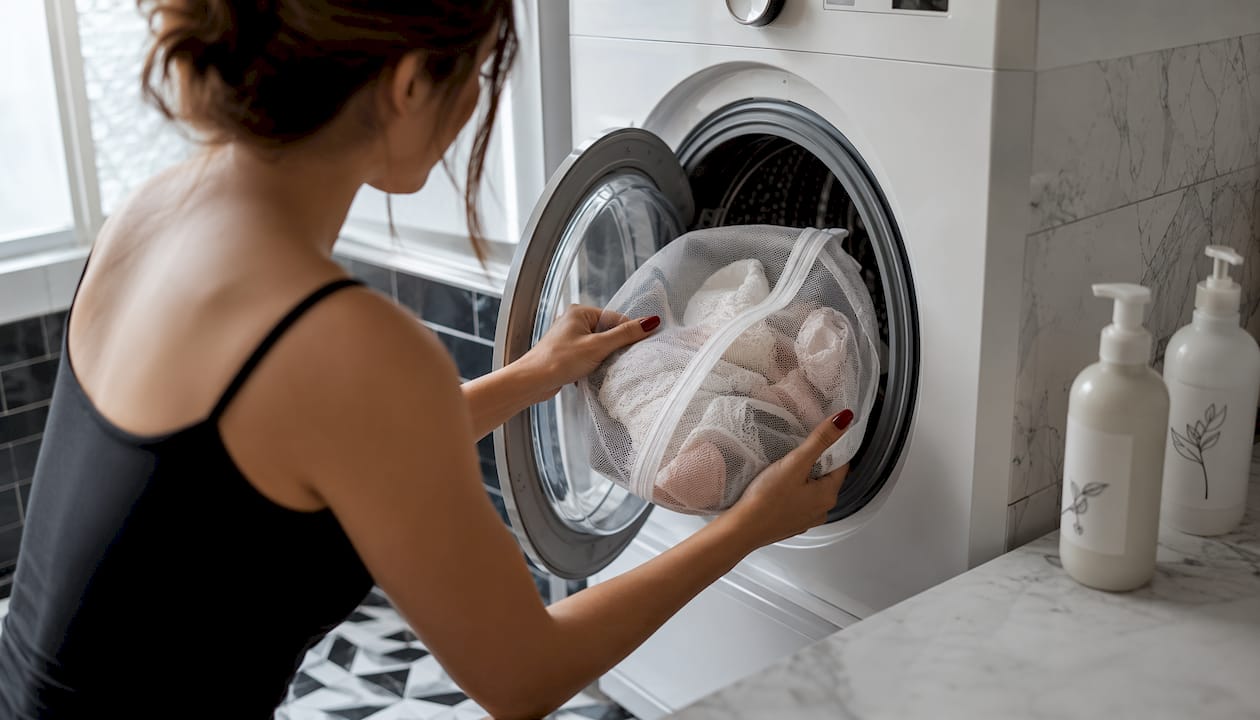
Machine washing is acceptable for many delicates when you follow strict preparation steps. The key is reducing mechanical stress: a mesh laundry bag, the coldest temperature setting and the gentlest cycle available.
Pre-wash checklist:
- Fasten all hooks and eyes to prevent snagging other items
- Place each piece in a dedicated mesh laundry bag
- Separate darks, lights and brights to prevent dye transfer
- Never overload the machine; small loads protect shape
| Setting | Recommendation |
|---|---|
| Cycle | Delicate or hand-wash cycle |
| Temperature | Cold |
| Spin speed | Lowest available |
| Load size | Small; 2–3 delicate items maximum |
| Detergent | Mild, enzyme-free; half the standard dose |
Underwired and padded bras need extra care in the machine. The mesh bag and delicate cycle combination reduces the risk of underwire distortion and padding compression, but hand-washing remains the safer choice for structured pieces. Never machine-wash items labelled “hand wash only.”
What detergents and products should you use?
Choose mild, enzyme-free detergents in small doses. Enzymes in standard laundry detergents break down protein-based fibres — silk and wool — and can weaken elastane over repeated washes.
Use:
- Detergents labelled “delicate,” “gentle” or “lingerie wash”
- Baby shampoo as a low-cost alternative for occasional hand-washing
- Oxygen-based bleach only if the care label explicitly permits bleaching
Avoid:
- Chlorine bleach — causes irreversible colour loss and fibre damage
- Heavy fabric softeners — coat elastic fibres and reduce stretch recovery
- Standard biological detergents with enzymes
- Washing pods or concentrated tablets that may not dissolve fully in cool water
Supportive accessories worth having:
- Mesh laundry bags (one per garment for machine washing)
- Padded or velvet hangers for drying and storage
- Breathable cotton or muslin storage pouches for long-term keeping
Pro Tip: Use half the detergent dose the packet recommends. Residue left in elastic fibres from excess detergent is a common cause of band stiffness and premature wear.
How should you dry bras, lace and other delicate items?
Never tumble dry lingerie. Heat from a dryer permanently degrades elastane, destroys elastic memory and can warp moulded cups in a single cycle. Air-dry every piece, away from direct heat sources and sunlight.
Drying dos and don’ts:
- Do lay moulded bras flat or drape over a towel rack with the cups facing up
- Do hang lace bralettes and soft-cup styles over a dry towel or a padded hanger
- Do reshape cups and straps immediately after the towel-press step
- Don’t hang bras by one strap — the weight distorts the band
- Don’t dry near radiators, heaters or in direct sunlight; UV fades colour and heat breaks down fibres
- Don’t use a tumble dryer on any setting, including “air only”
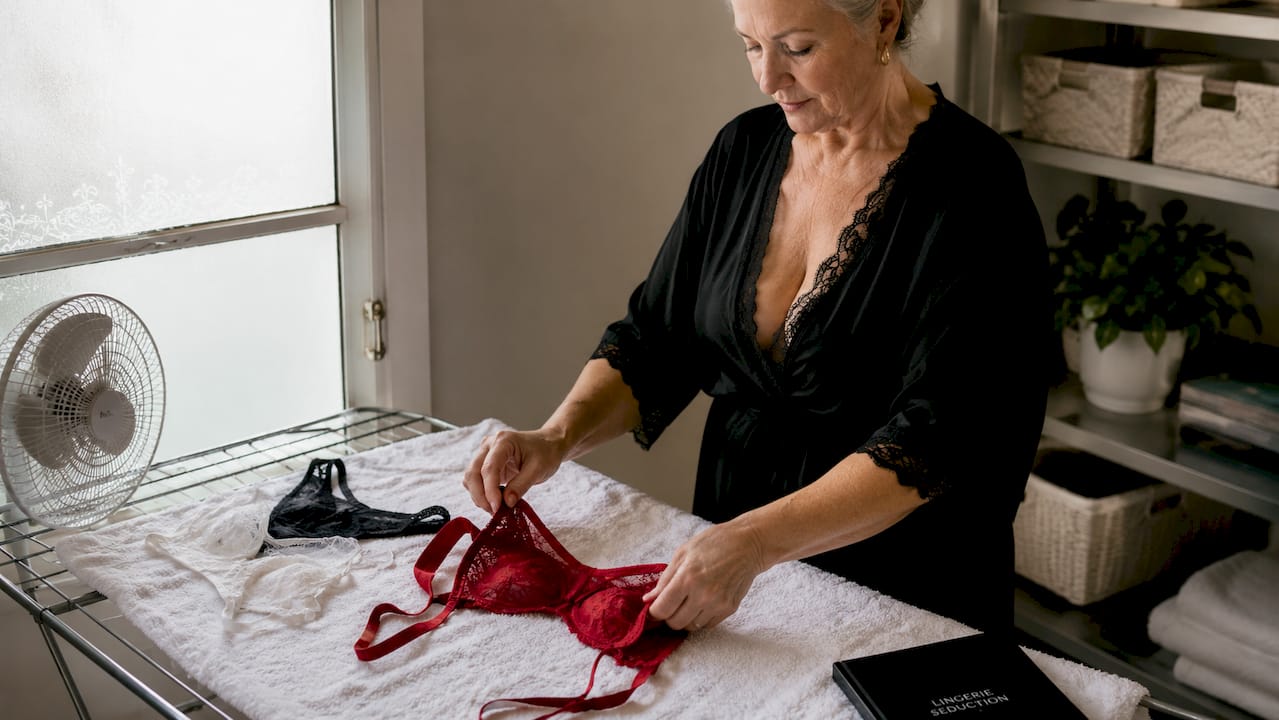
For specific garments: a moulded bra dries best face-up on a flat surface. A lace bralette can drape over a towel rail. A silk chemise should lie flat on a clean towel, reshaped gently before it sets.
Pro Tip: Speed up drying safely by placing the towel-pressed garment near a fan on a low setting. Airflow without heat dries most pieces in 2–3 hours without any fibre stress.
How should you store lingerie to protect cup shape and fabric?
Store to maintain shape. Stacking cups inside each other, folding cups inward or cramming bras into a drawer are the fastest routes to permanent cup deformation.
Short-term drawer storage:
- Stand moulded bras upright in a row, cups facing up, one behind the other
- Never fold one cup inside the other — it collapses the foam or padding
- Keep soft-cup and unlined bras flat or loosely folded
Long-term and seasonal storage:
- Wrap delicate pieces individually in acid-free tissue paper
- Store in breathable boxes or cotton pouches; avoid plastic bags that trap moisture
- Add cedar blocks or dried lavender sachets to deter moths without chemical residue
Storage by bra type:
- Moulded/padded: upright, cups facing up, never stacked flat
- Underwired: avoid tight spaces that bend the wire
- Unlined/soft-cup: can fold loosely; no rigid structure to protect
Pro Tip: Travelling with a moulded bra? Pack socks or a soft item inside each cup to hold the shape, then place the bra at the top of your bag where it won’t be compressed.
What care does each fabric type need?
Different fabrics need different handling. Applying the wrong method — even once — can cause irreversible damage to lace, silk or elastane.
| Fabric | Ideal wash | Temperature | Drying | Special notes |
|---|---|---|---|---|
| Lace | Hand-wash | Cool temperature recommended | Flat, away from sun | Support the full piece; never stretch |
| Silk | Hand-wash | Cool temperature recommended | Flat on towel | No wringing; no direct sunlight |
| Satin | Hand-wash | Cool temperature recommended | Flat or hang | Iron only on reverse, low heat |
| Microfibre | Hand-wash or delicate machine | Cold | Flat or hang | Avoid fabric softener; it clogs fibres |
| Elastane/spandex | Hand-wash | Cool water | Flat | Heat is the primary enemy; never tumble dry |
| Cotton | Hand-wash or delicate machine | Warm water | Hang or flat | Wash darks separately to prevent fading |
For lace specifically, the correct hand-wash technique matters as much as temperature. Support the full piece in the water rather than holding it by one edge, which stresses the threads. Metallic threads, beading and glued trims need spot-cleaning only — submerging them risks adhesive failure and thread breakage. PVC or vinyl panels should be wiped with a damp cloth, never submerged.
The elastic components in most lingerie are elastane-based. Heat is their primary enemy — hot water, tumble dryers and radiators permanently reduce stretch and shape retention.
How do you remove stains from delicate lingerie safely?
Treat stains promptly and with methods matched to the fabric. The longer a stain sits, the harder it is to remove without aggressive products that damage delicate fibres.
Step-by-step spot treatment by stain type:
- Deodorant/antiperspirant: Dampen the area with cool water. Apply a small amount of white vinegar or a delicate detergent directly to the mark. Gently work in with a soft cloth. Rinse with cool water.
- Body oil/moisturiser: Blot (never rub) with a clean cloth to absorb excess. Apply a tiny drop of mild dish soap or delicate detergent. Work in gently, then rinse thoroughly.
- Blood: Use cold water only — hot water sets blood permanently. Soak the spot in cold water, then apply a small amount of enzyme-free detergent or hydrogen peroxide (test on an inconspicuous area first on coloured fabrics).
- Makeup: Blot with a damp cloth. Apply micellar water or a gentle makeup remover to the spot, then rinse with cool water.
For minor repairs: a loose strap can often be resewn with a needle and matching thread. A popped hook needs replacing rather than bending back. Small lace tears are best left to a professional seamstress who works with delicate fabrics. Attempting to glue lace at home usually causes stiffness and discolouration.
Pro Tip: Rinse the stained area with cool water before the full wash cycle. Putting a stained garment through a wash without pre-treating often sets the stain permanently.
How often should you wash lingerie?
Wash frequency balances hygiene with garment longevity. Washing too often accelerates wear; washing too rarely affects hygiene and fabric freshness.
General frequency guide:
- Everyday bras: Every 2–3 wears, depending on activity and perspiration
- Underwear/briefs: After every wear
- Chemises and sleepwear: Every 2–3 wears
- Corsets and structured bodices: Spot-clean after each wear; full wash every 4–6 wears
- Lace overlays and delicate sets: After each wear if worn against skin; every 2–3 wears if layered
The 3-bra rule: Rotate at least three bras in regular use. Each bra needs 24–48 hours of rest after wearing to allow the elastic to recover its shape. Wearing the same bra every day accelerates elastic fatigue far faster than washing frequency alone. Deviate from this rule when you exercise heavily or perspire significantly — wash after each wear in those cases.
Quick answers:
- How many wears before washing a bra? Two to three wears for everyday styles; one wear for sports or high-perspiration activity.
- When is spot-cleaning enough? For structured or lightly worn pieces with no odour or visible marks, spot-cleaning extends the time between full washes.
What do care labels in Australia mean, and why do they matter?
Care labels in Australia are mandatory for most new textile products under the Consumer Goods (Care Labelling) Information Standard 2023. Following them protects your garment and your consumer rights under Australian Consumer Law.
The five internationally recognised care symbols:
- Washtub: Washing method and temperature (a hand inside = hand-wash only; a cross = do not wash)
- Triangle: Bleaching (empty = bleach permitted; crossed = do not bleach; two lines = non-chlorine bleach only)
- Square: Drying method (lines inside = hang or lay flat; circle inside = tumble dry; cross = do not tumble dry)
- Iron: Ironing temperature (one dot = low; two dots = medium; three dots = high; cross = do not iron)
- Circle: Professional care or dry-cleaning instructions
For lingerie, the most relevant symbols are the hand-wash washtub, the crossed tumble-dry square and the crossed bleach triangle. A crossed iron is common on lace and synthetic trims. Under the 2023 standard, suppliers must ensure care instructions cover all components of a garment — including trims, padding and lace — not just the main fabric. Labels that are overly cautious or misleading can breach the standard.
The 2023 standard aligns with AS/NZS 1957:1998 and ISO 3758:2012, which means the symbols on Australian-sold garments match those used internationally.
Key insight: Care labels in Australia are not optional suggestions. They are part of a mandatory information standard. Following them also maintains the garment’s acceptable quality status under Australian Consumer Law — relevant if you ever need to make a return or warranty claim.
Pro Tip: If a label has worn off or become illegible, check the product page on the retailer’s website. Many online retailers, including Lingerie Seduction, list care instructions in the product description.
What are the most common care mistakes that shorten lingerie life?
The biggest mistakes are also the most common. Most damage is irreversible once it occurs.
Top mistakes:
- Tumble drying — destroys elastic memory permanently in a single cycle
- Wringing or twisting to remove water — breaks elastics and distorts cups
- Using chlorine bleach — causes immediate colour loss and fibre degradation
- Washing in hot water — degrades elastane and causes dye bleed
- Ironing directly on lace or synthetic trims — melts fibres and causes permanent marks
- Storing bras folded with cups pressed inward — collapses padding that cannot recover
- Washing with rough items like denim or towels — causes abrasion and pilling on delicate fabrics
Warning signs of irreversible damage:
- Band no longer springs back after stretching (elastic loss)
- Cups hold a flattened or asymmetric shape (cup deformation)
- Colour patches or streaks on fabric (dye bleed from incorrect washing)
- Lace threads pulling or fraying at edges (abrasion damage)
Quick fixes:
- Replace the tumble dryer with a towel-press and fan-assisted air-dry
- Switch to a mesh bag and delicate cycle for machine washing
- Move detergent to a delicate or enzyme-free formula
Key takeaways
Proper lingerie care requires cool water, mild enzyme-free detergent, air-drying away from heat, and correct storage to maintain shape and extend garment life.
| Point | Details |
|---|---|
| Always air-dry | Never tumble dry; heat permanently degrades elastane and destroys elastic memory. |
| Hand-wash first | Cool water and a mild detergent is the safest method for lace, silk and structured pieces. |
| Rotate three bras | Resting each bra 24–48 hours between wears extends elastic life significantly. |
| Read care labels | Australian law mandates labels on most new textiles; following them protects fit and consumer rights. |
| Lingerie Seduction | Shop pieces designed for longevity and check product pages for fabric-specific care instructions. |
The case for slowing down your wash routine
Most lingerie damage is self-inflicted and entirely avoidable. The tumble dryer is the single biggest culprit — it degrades elastane in one cycle in a way that no amount of careful hand-washing can reverse. Yet it remains the default for many people simply because it is fast.
The conventional advice to “just use a delicate cycle” understates the risk. A delicate machine cycle is safer than a standard one, but it still exposes elastic and lace to mechanical stress and spin forces that hand-washing avoids entirely. For structured pieces — moulded bras, underwired sets, anything with padding — hand-washing is not the cautious option. It is the correct one.
Storage is equally underestimated. Folding a moulded cup inward once may seem harmless, but repeated compression collapses the foam permanently. The fix costs nothing: stand bras upright in a drawer, cups facing up. That single habit change preserves shape longer than any specialist detergent.
The pieces worth caring for most carefully are often those bought for a specific occasion — bridal sleepwear, a special set, a silk chemise. Those are exactly the pieces most likely to be washed incorrectly in a rush. Slow the routine down for those items and the investment holds.
Lingerie Seduction: quality pieces built to last
Good care starts with knowing what you are working with. Lingerie Seduction stocks premium styles across lace, microknit and silk-finish fabrics, each with clear care instructions on the product page so you know exactly how to handle them from day one.
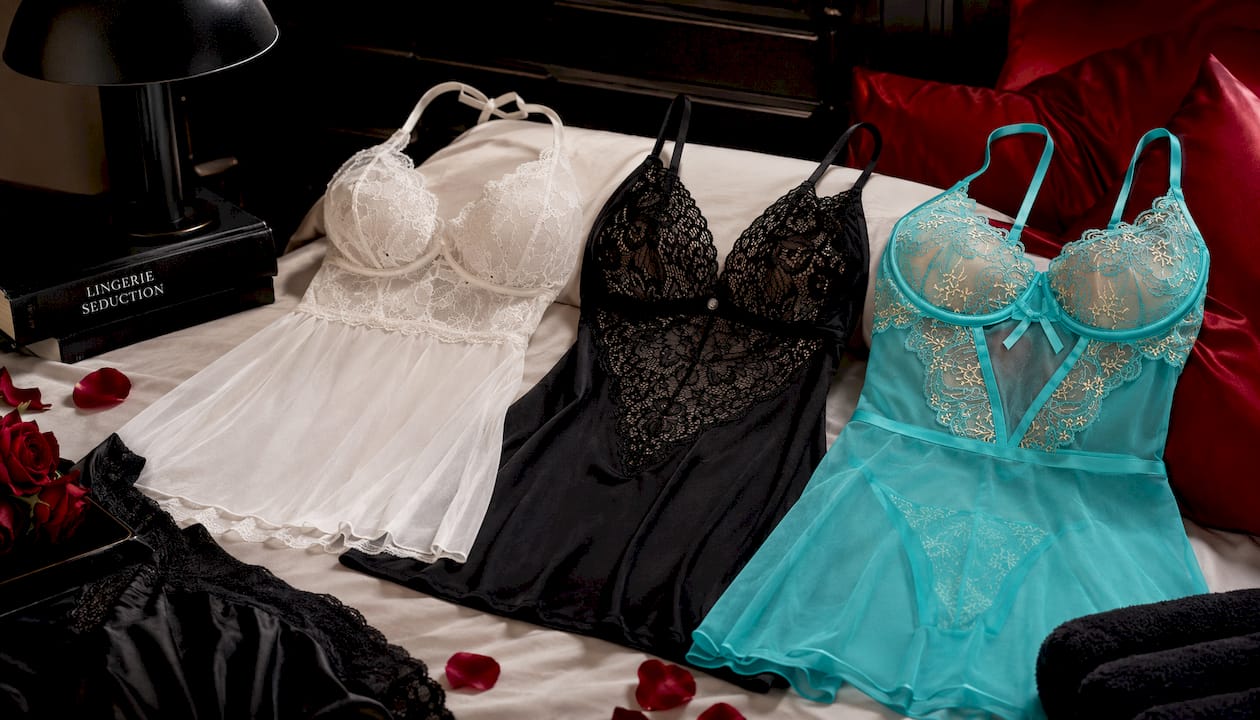
The Sexy Black Lace & Microknit Sleepwear Set is a practical example: the microknit panels hand-wash beautifully in cool water, while the lace trim needs gentle support during the rinse. Every product description includes the care detail you need. Free shipping on orders over $100 and hassle-free returns make it straightforward to find the right piece. Browse the full collection at Lingerie Seduction and check the product page for fabric-specific care notes before your first wash.
Useful sources and references
Key Australian and practical references used in this article:
- Care labelling on clothing and textiles guide | Product Safety Australia — the primary Australian consumer guide to mandatory care labelling requirements.
- Consumer Goods (Care Labelling) Information Standard 2023 | Federal Register of Legislation — the full legislative text, including transitional provisions and symbol requirements.
- Australia updates care labelling requirements | SGS Australia — industry summary of the 2023 standard and its alignment with AS/NZS 1957:1998 and ISO 3758:2012.
- How to wash lingerie properly | Lingerie Seduction — practical step-by-step washing guide from Lingerie Seduction.
- Washing symbols explained | HowStuffWorks — accessible reference for interpreting international care symbols.
- How to wash and care for your bikini | Doll House Bikinis — practical overlapping guidance on hand-washing delicate stretch fabrics.
FAQ
What is the 3-bra rule?
The 3-bra rule means rotating at least three bras in regular use so each one gets 24–48 hours of rest between wears, allowing the elastic to recover its shape and extending overall garment life.
How many times should you wear a bra before washing it?
Two to three wears is the standard guideline for everyday bras. Wash after every wear if you exercise heavily or perspire significantly.
Does machine washing damage lingerie?
Machine washing can be safe when you use a mesh laundry bag, the delicate or hand-wash cycle, cold water and the lowest spin speed. Hand-washing remains the safer choice for structured, underwired or heavily embellished pieces.
How do you read care label symbols on lingerie in Australia?
Australian care labels use five internationally recognised symbols: a washtub for washing, a triangle for bleaching, a square for drying, an iron for ironing and a circle for professional care. A cross through any symbol means that action is not permitted. Under the Consumer Goods (Care Labelling) Information Standard 2023, these labels are mandatory on most new textile products sold in Australia.
Can you tumble dry lingerie on a low heat setting?
No. Even a low heat setting degrades elastane fibres and reduces elastic memory. Air-drying away from direct heat is the only safe drying method for lingerie.


