

How straps shape support and sex appeal in lingerie
Straps do two jobs at once in sexy lingerie: they provide the mechanical lift that keeps a piece in place, and they create the visual lines that make a design deliberately alluring. That dual role is what separates a well-engineered strap from a decorative afterthought. In functional terms, straps control vertical displacement of the bust while the band manages back support. Aesthetically, strap placement, width, and finish frame the body in ways that no other design element can replicate. The role of straps in sexy designs is not incidental — it is structural, both literally and visually.
Straps, treated as jewellery using jacquard, split constructions and premium hardware, represent the clearest signal that lingerie design has shifted from hidden utility to visible fashion statement.
Quick summary of what straps actually do:
- Lift and support — control vertical position of the bust and distribute load across the shoulder
- Positioning and stability — keep cups seated correctly through movement
- Silhouette shaping — narrow or wide straps alter perceived shoulder width and torso length
- Decorative framing — colour, texture and construction draw the eye and define the look
Table of Contents
- How do straps actually support and position the bust?
- What materials and construction determine how straps feel and last?
- What design techniques make straps deliberately sexy?
- How do you adjust straps correctly and spot hardware problems?
- How do you style exposed straps intentionally?
- How do you care for decorative and functional straps?
- Why have straps become a focal design element?
- Which strap style suits your goal?
- Key takeaways
- Strap-first design: Lingerie Seduction’s position
- Strap-forward pieces at Lingerie Seduction
- Useful sources
- FAQ
How do straps actually support and position the bust?
The load in a bra is shared between the band and the straps, but not equally. The band carries the majority of back support; straps control vertical displacement and keep cups from dropping forward. When a band fits correctly, straps need only a light, consistent tension — they should not be doing the heavy lifting alone.
Strap width scales directly with support requirements. Strap widths range from 6 mm for delicate bralettes up to 25 mm for maximum support, but most everyday styles use straps in the 10–15 mm range. Narrow straps at 6–8 mm suit bralettes and light-support pieces where the band does most of the work. Fuller-bust styles need straps approaching 25 mm to spread load across the shoulder without digging.
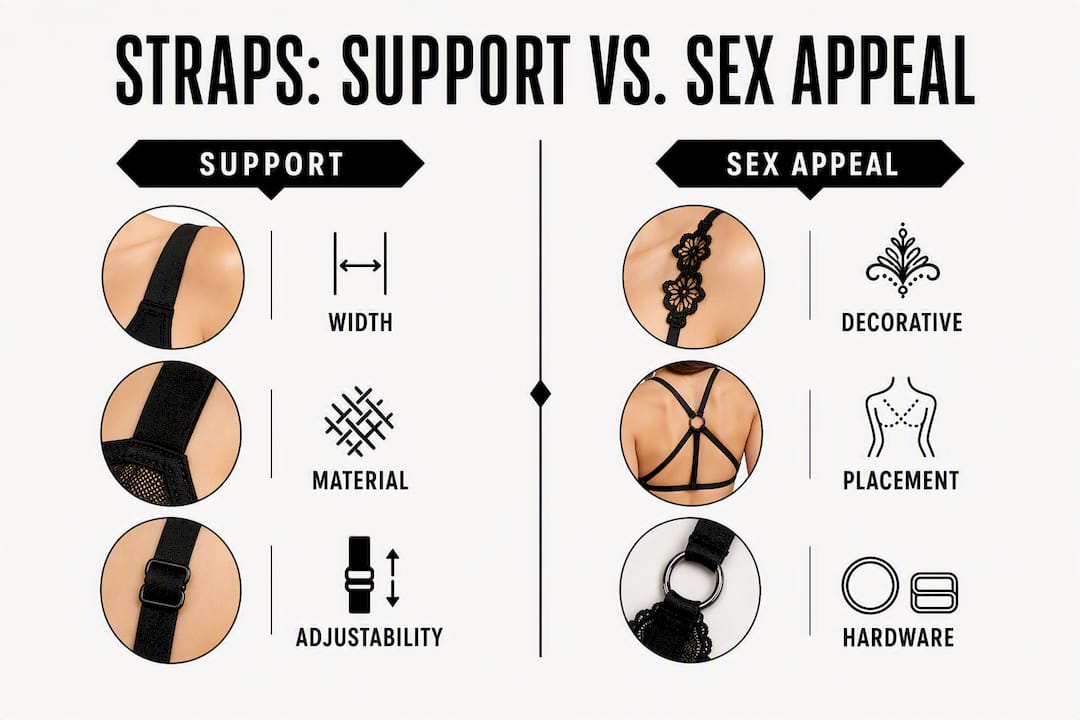
Shoulder slope varies across adult female populations, highlighting the need for adjustable straps, which is why adjustable dual-point sliders are not optional on a well-made piece. A fixed-length strap that fits one shoulder geometry will slip, dig, or sag on another. Torso length adds a second variable: a longer torso needs more strap length to maintain the same cup position, and a shorter torso needs less. Without independent left/right adjustment, these differences compound into fit failures within an hour of wear.
Common strap-related fit failures and their causes:
- Slipping straps — band too loose, strap too long, or shoulder slope too steep for the slider range
- Digging straps — strap too short, width too narrow for the load, or elastic too firm
- Sagging cups — strap tension too low or band riding up, shifting the load to the strap incorrectly
Posture is also affected. Straps set too far toward the neck pull the shoulders forward; straps set too wide toward the arm cause the cups to gap. The correct placement sits roughly 7–8 cm apart at the back, angled to follow the natural shoulder line.
What materials and construction determine how straps feel and last?
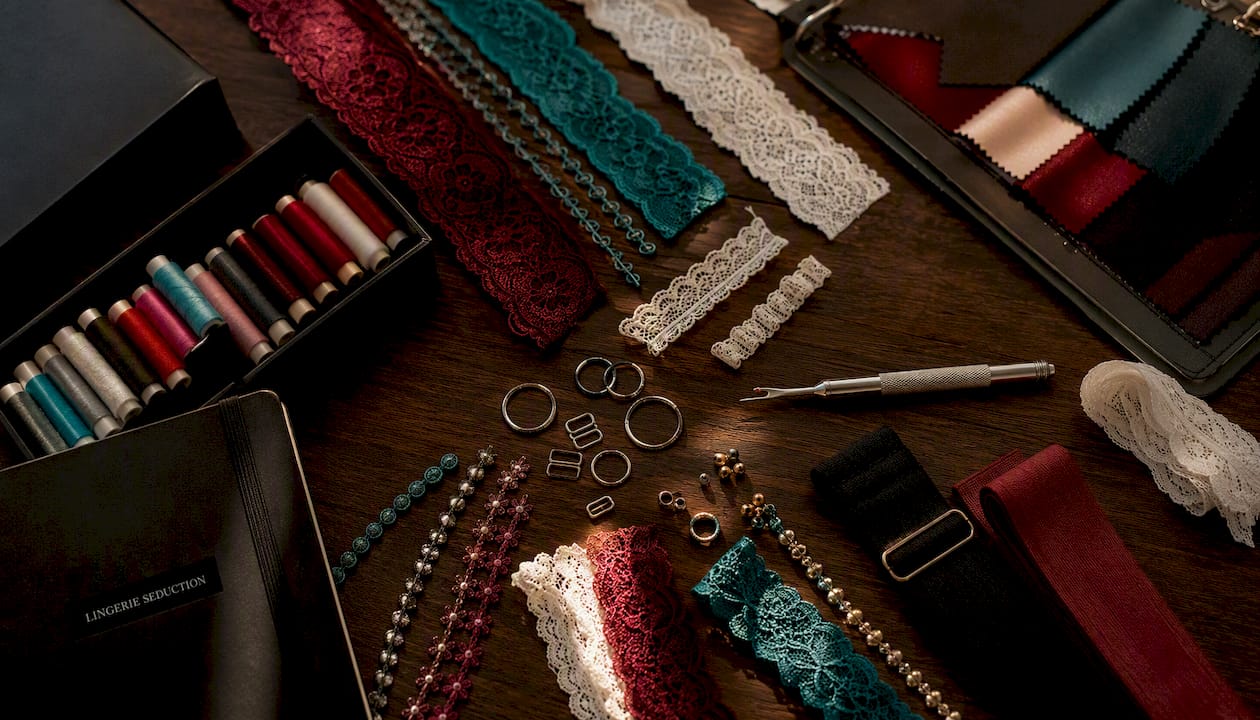
The feel, stretch, and durability of a strap come down to three choices: elastic type, surface material, and hardware. Getting these right is what separates a piece that holds up through a full evening from one that loses its shape after two wears.
Knit vs woven elastic
Knit elastic is softer and more conforming — it moves with the body and recovers well after repeated stretch cycles. Woven elastic is firmer and less stretchy, which makes it better for structured support straps where you want minimal elongation under load. Manufacturers increasingly blend wide-and-narrow elastic tapes to balance support and softness, giving designers more expressive options without sacrificing comfort.
Decorative surface options
- Faux leather — firm, structured, adds an edgy finish; not breathable, so best for shorter wear periods
Hardware
Sliders should be nickel-free or hypoallergenic-finished for skin comfort. The slider material affects how many adjustment cycles it can handle before the grip weakens — cast metal sliders outlast plated zinc versions significantly. Clasps at the back should be stitched through multiple layers at the junction point; a single-thread attachment at a strap join is a rejection signal at purchase.
| Material | Feel | Stretch | Durability | Best use |
|---|---|---|---|---|
| Woven elastic | Firm | Low | High | Structured support straps |
| Knit elastic | Soft | Medium–high | Medium | Everyday and bralette styles |
| Silk-blend strap | Smooth, luxe | Low | Medium | Bridal, special occasion |
| Faux leather | Stiff, textured | Very low | Medium | Fashion/harness pieces |
| Lace overlay | Delicate | Low | Low–medium | Decorative, light-wear |
The role of elastic in lingerie goes beyond stretch — recovery rate after repeated wear is what determines whether a strap still provides the same tension after six months.
What design techniques make straps deliberately sexy?
The shift from functional to centre-stage happens through construction choices, not just decoration. Split-strap and multi-strap constructions create layered, dimensional effects that draw the eye across the shoulder and collarbone. A single strap carries load; two or three parallel straps at different widths create geometry that reads as intentional design.
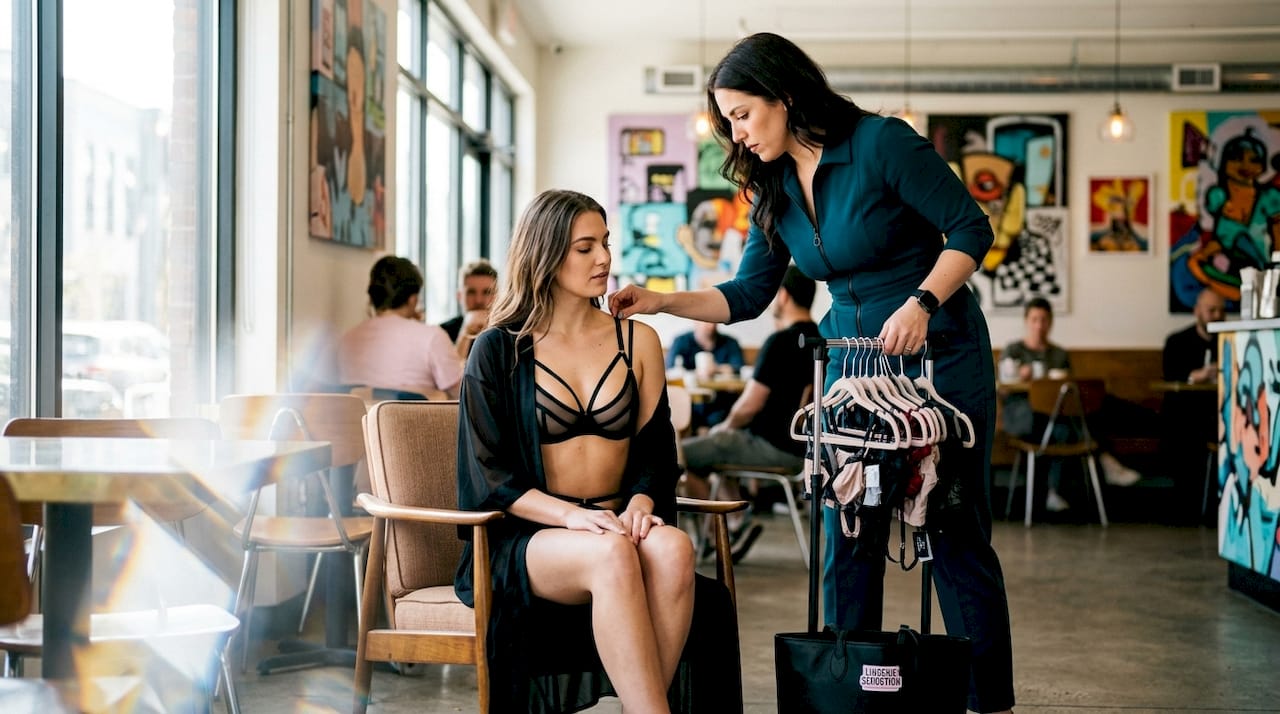
Harness constructions extend this further. A strappy harness garter uses straps to frame the torso and thighs, creating compositional lines that work both standing and lying down. In boudoir photography, strap tension and placement are actively adjusted mid-shoot to shift a look from relaxed to structured — tighter tension creates sharper lines, looser tension gives a softer, more draped effect.
Decorative trims change the register of a strap entirely:
- Chain straps — add movement and sound; the metallic finish creates contrast against skin and fabric
The risk with heavy decorative trims is fit compromise. Rhinestone-encrusted straps are often fixed-length, which removes adjustability. The workaround is to choose pieces where the decorative element sits on a separate overlay strap while the load-bearing strap beneath remains adjustable.
Pro Tip: When choosing a decorative harness or strappy piece, check that the primary load-bearing strap has its own slider separate from any decorative overlay. This preserves adjustability without sacrificing the visual effect.
How do you adjust straps correctly and spot hardware problems?
Getting strap length right is a three-step process:
- Front view check — straps should lie flat against the shoulder with no gap and no indentation. If they gap, shorten; if they leave a red mark within 10 minutes, lengthen.
- Side view check — the back of the bra should sit level with the front underwire. If the back rides up, the straps are too short and are pulling the band upward.
- Movement check — raise both arms overhead. Straps should stay on the shoulder without slipping. If they slip, shorten slightly; if they dig on the raise, lengthen.
Independent left/right adjustment matters because most people have a dominant shoulder that sits slightly lower. A single-point slider shared between both straps cannot compensate for this asymmetry.
Poor adjustability is the most common cause of strap-related fit failure — shoulder slope can vary by ±12° across adult female populations, making dual-point independent sliders a functional necessity, not a luxury.
Hardware warning signs to reject at purchase:
- Sliders that bind or skip rather than moving smoothly through their full range
- Stitching at strap-to-band junctions that uses a single thread line rather than a bar tack or box stitch
- Plated hardware with visible flaking or uneven coating at the edges
- Rings or clasps that flex under light hand pressure
How do you style exposed straps intentionally?
Visible bra straps are a deliberate fashion choice when the strap is treated as part of the outfit. The difference between “accidental” and “intentional” is contrast and coordination.
Practical styling guidance:
- Under sheer or mesh tops — choose a strap in a contrasting colour or texture (black lace under white mesh, for example) so the strap reads as a layer, not an oversight. Pair with see-through lingerie styles designed for visible wear.
- Under blazers — a thin jacquard or satin strap visible at the shoulder adds detail without bulk. Avoid wide straps here; they compete with the jacket’s shoulder line.
- Evening looks — rhinestone or chain straps visible above a low-back dress or bodysuit read as jewellery. Match metal tone to other accessories.
- Beach and casual Australian daywear — a bright or printed bralette strap under a linen shirt or cami is standard summer styling. Width and colour should coordinate with the outer layer.
Strap colour relative to skin tone and fabric matters. A nude strap against pale skin under a sheer fabric nearly disappears; a contrast strap in the same situation creates a graphic line. Neither is wrong — the choice depends on whether you want the strap to be seen or to support invisibly. For strapless gowns and formal events, how undergarment straps interact with dress choices is worth considering before the event, not during it.
How do you care for decorative and functional straps?
Elastic degrades faster than any other component in a lingerie piece. Heat is the primary cause — machine washing on a warm cycle, tumble drying, or leaving pieces in direct sunlight all accelerate elastic breakdown.
Care rules by material:
- Elastic straps (knit or woven) — hand wash in cool water with a gentle detergent, or use a mesh bag on a delicate machine cycle at 30°C maximum. Dry flat, away from direct heat.
- Lace overlay straps — hand wash only. Lace snags easily in machines even with a mesh bag. Lay flat to dry; never wring.
- Faux leather straps — wipe clean with a damp cloth. Do not submerge or machine wash. Store away from heat to prevent cracking.
- Silicone-finished straps — hand wash; avoid fabric softener, which degrades the silicone grip coating.
Replacement indicators:
- Elastic that does not recover to its original length within 30 seconds of being stretched
- Sliders that no longer hold position under light tension
- Stitching at junctions that has begun to fray or separate
A simple inspection before each wear takes 20 seconds: stretch each strap once, release, and check recovery. Check the slider grip by setting a length and pulling the strap end — if the slider moves, it needs replacing.
Why have straps become a focal design element?
The shift is documented across runway reports and elastic manufacturer data. Straps have evolved from hidden utility to visible design element, with high-end lingerie now treating them as jewellery through jacquard patterns, split constructions and premium hardware finishes.
Three trend drivers are pushing this:
- Y2K revival — the early-2000s aesthetic normalised visible bra straps as a style choice, and that influence is back in Australian retail and street style
- Wearer customisation — tie-shoulder and adjustable strap designs are growing because they let the wearer personalise fit and silhouette at the point of wear, described in fashion commentary as the “wearer-as-architect” shift
- Visible lingerie as outerwear — corsets, harnesses and strappy bodysuits worn as tops have moved from runway to mainstream Australian going-out dressing
Stylists now treat intentional strap exposure as empowering — visible straps paired with lace balconette or demi styles create a controlled, confident reveal rather than an accidental one.
Australian shoppers are engaging with these trends through strappy harness pieces, convertible bralettes and faux leather harness garters. For a broader view of where sexy lingerie trends are heading locally, the shift toward strap-forward design is consistent across price points.
Which strap style suits your goal?
Match your goal to the right strap construction before you buy:
- Everyday comfort — knit elastic, 10–15 mm width, adjustable dual-point sliders, neutral colour
- Visible fashion look — jacquard or contrast-colour strap, split or multi-strap construction, coordinated hardware
- Boudoir photography — harness or garter strap construction with adjustable tension; faux leather or satin for strong compositional lines
- Bridal — bonded seams, detachable or convertible straps, silk-blend or lace overlay, hypoallergenic hardware
- Active or fuller-bust wear — woven elastic, 18–25 mm width (with 25 mm suited for maximum support), silicone anti-slip finish, reinforced stitching at junctions
| Strap category | Suitability | Durability | Best use |
|---|---|---|---|
| Delicate/decorative | Low support, high visual impact | Low–medium | Special occasion, photography |
| Everyday support | Medium–high support (10–15 mm width common) | High | Daily wear, fuller bust |
| Convertible/harness | Variable support, high versatility | Medium | Fashion, going-out, bridal |
Strap systems that prioritise adjustability and engineered hardware reduce fit complaints and returns — a practical signal that the engineering behind the strap matters as much as the aesthetic.
Key takeaways
Straps in sexy lingerie designs work best when technical choices (width, material, adjustability) are made to serve both support and visual intent simultaneously.
| Point | Details |
|---|---|
| Width scales with support | Strap widths range from 6 mm for delicate pieces up to 25 mm for maximum support, with 10–15 mm most common for everyday styles; wider straps suit fuller-bust support. |
| Adjustability prevents fit failure | Shoulder slope varies by ±12°; dual-point independent sliders are necessary to accommodate this across body types. |
| Material determines longevity | Woven elastic lasts longer under load; knit elastic conforms better; faux leather requires wipe-clean care only. |
| Decorative and functional can coexist | Choose pieces where the load-bearing strap has its own slider, separate from any decorative overlay. |
| Lingerie Seduction | Offers harness garters, removable harness lace sets and faux leather harness pieces with adjustable hardware for both support and visible styling. |
Strap-first design: Lingerie Seduction’s position
Lingerie Seduction selects pieces where strap construction is a deliberate design decision, not an afterthought. Adjustable hardware, reinforced junctions and strap-forward silhouettes are consistent across the range. Whether you are looking for a harness garter for a going-out look or a convertible lace set with removable straps, the collection is built around fit that holds and aesthetics that are meant to be seen. View the full range at lingerieseduction.com.au.
Strap-forward pieces at Lingerie Seduction
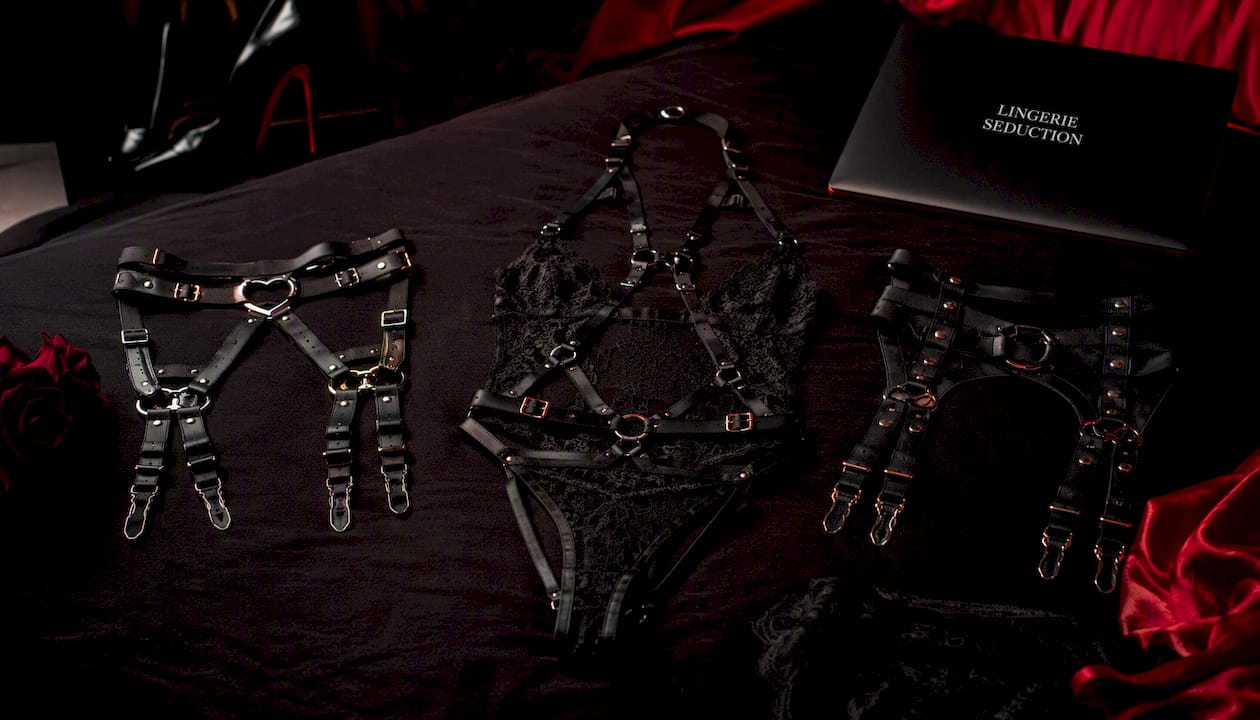
Three pieces that map directly to the use-cases covered in this guide:
The Sexy Straps Harness Garter Belt is built for visible evening styling. Multi-strap construction creates compositional lines across the torso and thighs, with adjustable hardware throughout. Best for going-out looks, boudoir photography, and any occasion where the strap is the centrepiece.
The Erotic Removable Harness Strappy Black Lace Lingerie suits wearers who want convertible options. The removable harness means you can wear it as a strappy statement or as a cleaner lace set depending on the look. Practical for those who want one piece to cover multiple styling scenarios.
The Bondage Style Faux Leather Harness Garter Belt delivers the structured, edgy finish that faux leather provides. The firm strap construction holds its shape through wear, and the hardware finish is suited to strong visual contrast against skin. Wipe-clean care only.
Free shipping on orders over $100. Hassle-free returns. Discrete packaging. Shop the full strap-forward range at lingerieseduction.com.au.
CMS note: add relevant tags to this blog post for discoverability (e.g. straps, harness, lingerie design, visible straps, garter belt).
Useful sources
- Lingerie shoulder strap design guide: materials, construction & comfort innovation (ECI) — covers elastic types, split-strap constructions, anti-slip finishes and the shift toward decorative strap engineering
- Elastic width guidance for lingerie (Kodlace) — documents the 6–25 mm strap width range and everyday 10–15 mm standard
- Adjustability and strap engineering for sensual lingerie (CN Lingerie Hub) — explains dual-point slider necessity, shoulder slope variance (±12°) and fit failure causes
- Visible bra straps are back — wardrobe stylist perspectives (HuffPost) — stylist commentary on intentional strap exposure and Y2K revival
- Why dresses with tie straps are taking over fashion (Hautestyle) — covers the wearer-as-architect trend and adjustable strap design growth
- Boudoir garter belt styling and strap tension techniques (Boudoir Inspiration) — practical notes on strap tension manipulation in photography contexts
- The role of elastic in lingerie: fit, comfort, and design (Lingerie Seduction) — elastic behaviour, recovery rates and longevity guidance
- Sexy lingerie trends to know in 2026 (Lingerie Seduction) — Australian market context for visible strap and harness trends
FAQ
What is the main role of straps in sexy lingerie designs?
Straps provide mechanical support by controlling vertical bust displacement and create visual framing that defines the aesthetic of a piece. In strap-forward designs, they function as both structural and decorative elements simultaneously.
Why do bra straps keep slipping off the shoulder?
Slipping straps are usually caused by a band that is too loose, straps set too long, or a shoulder slope that falls outside the slider’s adjustment range. Independent dual-point sliders and a correctly fitted band resolve most slipping issues.
Is showing your bra straps a fashion choice or a mistake?
Stylists treat visible straps as a deliberate statement when the strap is chosen to coordinate with the outfit. Lace, jacquard, and chain straps visible under sheer tops or evening looks read as intentional; a plain nude strap visible under a formal dress typically does not.
What is the 3 bra rule?
The 3 bra rule is a practical wardrobe guideline suggesting most people need three core bra styles: an everyday T-shirt or smooth-cup bra, a strapless or convertible option for specific necklines, and a decorative or special-occasion piece. It is a simplification, not an industry standard, but it covers most outfit scenarios efficiently.
How do you care for straps to keep them lasting longer?
Hand wash elastic and lace straps in cool water, dry flat away from heat, and avoid fabric softener on silicone-finished straps. Faux leather straps should be wiped clean rather than submerged. Replace any strap where the elastic no longer recovers its original length within 30 seconds of being stretched.
Recommended
- The Role Of Fit in Sexy Lingerie: Your Complete Guide – Lingerie Seduction
- Lingerie for different body types: your fit guide – Lingerie Seduction
- Erotic Removable Harness Strappy Black Lace Lingerie - Lingerie – Lingerie Seduction
- The Best Bra for Lift and Side Support: Your 2026 Guide to a Stunning – Lingerie Seduction


