

Stop Buying the Wrong Size: Panty Size Guide Based on Hip Measurement
Measure your hips at the fullest point and match that number to a size chart. That single measurement decides your panty size far more reliably than waist or your usual dress size, because most panty styles sit across the hips and buttocks. If you land between two sizes, size up for comfort. High-waist and low-rise cuts are the exceptions worth checking against your waist too.
TL;DR:
- Most panty sizes are determined by hip measurement, with the range from 88 to 115 centimeters corresponding to XS through XL, and hip measurement taking precedence over waist.
- For best fit, measure hips snugly at the fullest point while wearing light clothing or your usual underwear, and re-measure annually or after body changes.
- Style and fabric heavily influence fit, with stretchy materials forgiving sizing, while less elastic fabrics like lace often require more precise measurements.
- If between sizes, select the larger for comfort, and always check the specific brand’s size chart, as sizing consistency varies across labels.
- Accurate fit can be achieved by verifying measurements with external guides like Nike or Triumph, and by ordering both sizes if unsure, then returning the ill-fitting item.
Table of Contents
- How do I measure for a panty size guide?
- What panty size chart should I use?
- How does style and fabric change your panty size?
- Why do my panties dig, roll, or ride up?
- What sizing resources does Lingerie Seduction offer shoppers?
- Panty size guide: what actually matters most
- Find your size, then find your set
- Where to check your measurements further
- Sources
- FAQ
How do I measure for a panty size guide?
Grab a soft measuring tape, a mirror, and wear light clothing or your usual underwear. A fabric tape gives a far more accurate read than a rigid ruler pressed against your body.
- Hips: Stand with your feet together and wrap the tape around the fullest part of your hips and buttocks, keeping it level all the way around.
- Tension: Keep the tape snug against your skin but not pulled tight. It should sit flat without indenting.
- Waist: Find your natural waist, the narrowest point above your belly button, and breathe normally while you measure.
- Record: Round to the nearest centimetre. Centimetres are the standard unit on most Australian and international size charts, so work in cm rather than converting from inches on the fly.
- Repeat: Measure twice and use the average if your two readings differ.
Measuring over the underwear you’d normally wear gives a truer everyday number than measuring bare skin, since fabric and seams add a small amount of bulk. This mirrors the step by step approach Wacoal recommends: hips first, waist second, hips as the deciding factor if the two disagree.
Pro Tip: No tape measure handy? Wrap a length of string around your hips, mark where it overlaps, then lay it flat against a ruler. It’s a rough but genuinely workable substitute measuring method when you need a number in a hurry.
What panty size chart should I use?
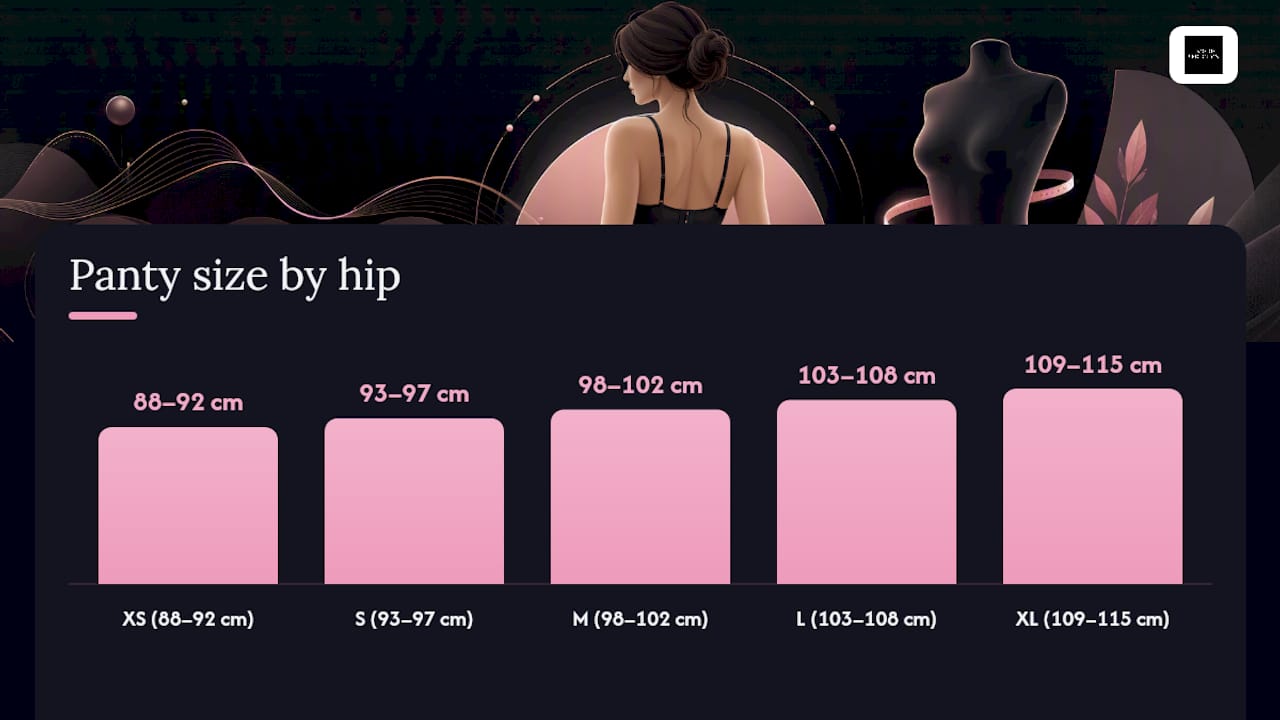
Once you have your hip figure in centimetres, match it against a standard alpha size chart. This one reflects the ranges most Australian lingerie retailers use as a baseline.
| Hip measurement (cm) | Size |
|---|---|
| 88 to 92 | XS |
| 93 to 97 | S |
| 98 to 102 | M |
| 103 to 108 | L |
| 109 to 115 | XL |
If your hip and waist measurements point to different sizes, go with the hip number. Nike’s own sizing guidance confirms hip measurement as the primary input for underwear fit, and for good reason: elastic edges, leg openings, and fabric panels are all cut to sit across the hip line.
Sitting right on the border between two rows? Choose the larger size. A little extra room around the hip beats a waistband that digs in by dinner time. And treat this chart as a starting point rather than gospel. Brands vary, so always check the size chart on the specific product page before you buy, particularly for seamless or heavily boned styles where the fit runs differently to a basic cotton brief.
How does style and fabric change your panty size?
Your hip measurement gets you into the right size bracket, but the cut and fabric decide how that size actually feels on your body.
- Thongs and G-strings have less fabric coverage, so they need more precise sizing. A loose thong rides and a tight one digs, with almost no forgiving middle ground.
- Boyshorts and briefs use more fabric and a full leg opening, which makes them more forgiving if you’re between two sizes.
- High-waist styles sit closer to your natural waist, so weigh your waist measurement more heavily here than you would for a low-rise cut.
- Stretchy fabrics like modal and elastane blends flex with your body, so sizing down slightly on a very stretchy seamless style rarely causes problems.
- Low-stretch fabrics like structured lace or satin hold their shape rather than moulding to you, so size up rather than squeezing into a snug fit.
A lace-heavy set behaves nothing like a jersey brief on the same body, even at the same labelled size.
Why do my panties dig, roll, or ride up?
Poor fit almost always shows up in one of a handful of familiar ways, and each one points to a specific fix.
- Digging elastic at the leg or waistband usually means the size is too small for your hip measurement. Try the next size up before assuming the style just isn’t for you.
- Rolling or bunching fabric at the crotch or waist often signals a size too large, or a cut that doesn’t suit your body shape.
- Constant riding up at the back points to a fabric with too little stretch for your movement, or a rise that sits too low for your torso length.
- Visible panty lines under clothing suggest trying a seamless style rather than sizing up in a lace brief.
If a re-measure still leaves you between two sizes, order both and keep whichever fits without adjustment after wearing it for an hour. Our guide to common sizing mistakes covers the fixes in more depth if the digging or rolling persists.
Pro Tip: Re-measure yourself every 12 months, and again after pregnancy, significant weight change, or a long gap since your last purchase. Bodies shift gradually, and the size you wore two years ago isn’t a guarantee today.
What sizing resources does Lingerie Seduction offer shoppers?
Getting sizing right shouldn’t rest on guesswork, which is why Lingerie Seduction backs every category with practical, measurement based resources rather than vague size labels.
- A dedicated walkthrough on how to measure lingerie size at home, covering bras and panties together.
- A breakdown of the top common lingerie sizing mistakes shoppers make and how to avoid them.
- Notes on how fit affects the way sexy lingerie actually looks and feels once worn.
- Free shipping on orders over $100 and hassle-free returns, so trying a second size if the first doesn’t sit right costs you nothing extra.
- Product pages that carry specific size guidance rather than a single generic chart for every style.
Clear size information on the product page, paired with a straightforward returns process, removes most of the risk from ordering online.
Panty size guide: what actually matters most
Most sizing advice online treats waist measurement as equal to hip measurement, and that’s the part worth pushing back on. It isn’t equal. Waist matters for a handful of high-waist and low-rise styles, but for the vast majority of panty cuts, the hip number does almost all the work, because that’s where the elastic and fabric panels actually sit.
The other place conventional advice falls short is fabric. Plenty of guides hand you a chart and stop there, as if every garment in a given size behaves the same way. A stretch seamless brief and a structured lace set in the same labelled size can fit completely differently on the same body. Reading the fabric is not optional extra credit. It’s the second half of the sizing decision, right after the tape measure.
If there’s one habit worth building, it’s re-measuring rather than assuming your size from three years ago still holds. Bodies change gradually enough that you won’t notice until a waistband that used to sit comfortably starts digging in. Regularly re-measuring your size can help ensure better fit and save effort compared to frequent returns.
— Lingerie Seduction
Find your size, then find your set
Once you know your number, the fun part starts: choosing the styles that suit how you want to feel. Lingerie Seduction’s collection spans everything this guide has covered, from forgiving stretch pieces to structured lace that rewards a precise fit.

For high-waist coverage that leans into your waist measurement as much as your hips, the Luxe Black & Nude Lace Corset Lingerie offers structured support with a true-to-size fit. If you prefer soft stretch that moves with your body, the Sexy Black Lace & Microknit Sleepwear Set blends microknit and lace for a fit that’s forgiving between sizes. Brides after something delicate might look to the Ivory & Champagne 3 Piece Bra & Garterbelt Set, while those wanting sheer coverage without a rigid structure will find the Luxury Sheer Mesh & Lace Women’s Babydoll Set and Sheer Peach Floral Lace Lingerie Set sit true to standard hip based sizing.
For fuller coverage with underwire support, the Luxury White Satin Microknit & Lace Underwire Bustier and Luxury Black Sheer Lace Lingerie Set both carry detailed size charts on their product pages. Prefer something with more drama? The Luxury Nude & Black Babydoll Lingerie Set suits a range of hip measurements thanks to its flowing cut.
Every product page lists its own size chart, and every order over $100 ships free with fast local dispatch and discreet packaging. If your measurement sits between two sizes, order both, keep the one that fits, and send the other back at no hassle.
Where to check your measurements further
A few external references back up the measuring method in this guide if you want a second source to check your numbers against. Nike’s underwear size guide explains hip-first measurement technique with clear diagrams. Wacoal’s measuring guide walks through the same hips-then-waist order in more detail. Triumph’s sizing page covers what to do when you’re stuck between two sizes, including the fabric stretch consideration. For general measuring technique beyond lingerie, EmpowerFit’s body measurement guide is a solid practical reference.
Sources
- Size guide and how to measure | Nike
- How to measure your panty size for the perfect fit – Wacoal India
- How to measure bra and panties size | Triumph
FAQ
How do I determine my panty size?
Measure around the fullest part of your hips with a soft tape, keeping it level and snug but not tight, then match that number to a size chart in centimetres. If your waist measurement suggests a different size, favour the hip number unless you’re buying a high-waist style.
Is a size 7 panty a medium or large?
Numbered sizing varies by brand and doesn’t map cleanly to alpha sizes across the board. Always check that specific brand’s own size chart rather than assuming a universal conversion.
What size panty fits a 36-inch waist?
A waist measurement alone doesn’t determine panty size, since hip measurement matters more for most styles. Measure your hips at the fullest point in centimetres and use that figure against the size chart, checking the waist only for high-waist or low-rise cuts.
What is a size 2 panty?
Like other numbered sizing, a size 2 varies between brands and doesn’t correspond to one fixed hip or waist measurement across the industry. Check the specific retailer’s chart, or measure your hips directly and use Lingerie Seduction’s sizing resources to convert that number to an alpha size.


