

7 Corset Boning Types Makers Use and Where to Place Them
Modern corset boning splits into two practical families: steel (flat/spring and spiral) and synthetic (German plastic, Rigilene, generic plastic strips). The quick rule of thumb is simple. Choose steel when you need serious waist reduction and long-term structure, and choose synthetic when you want a lighter, mouldable garment that still holds its shape. The rest comes down to sizing, placement and a few handling tricks that save both your fabric and your fingers.
TL;DR:
- Steel boning, especially flat and spiral, provides the highest support for waist reduction and long-term structure, but each type serves different panel needs.
- Synthetic plastic boning, like German plastic, offers flexibility and comfort, making it suitable for shaping and everyday wear without rust concerns.
- Rigilene and craft plastics are best for lightweight, non-structural garments, as they do not provide meaningful compression or support.
- Proper boning sizing and placement depend on panel function, with wider, reinforced bones at lacing channels and support bones at the centre front and sides.
- Buying pre-made boned corsets can save time and ensure correct construction, especially when structure and finish are priorities over DIY customization.
Table of Contents
- Corset boning types at a glance
- Steel boning: flat (spring) and spiral, and when to use each
- Synthetic boning: German plastic and modern plastics
- Rigilene, hoop boning, and other craft-friendly options
- Boning sizes, widths and placement guidance
- How to choose boning for your project
- Practical handling and installation tips
- What buying ready-made boned pieces gets you
- Why boning choice matters more than most patterns admit
- Prefer a ready-made boned corset over a DIY project?
- Sources
- FAQ
Corset boning types at a glance
Every corset boning type on the market falls somewhere between rigid support and flexible comfort, and knowing where each one sits saves you from buying the wrong roll.
- Flat (spring) steel: bends in one plane only, gives the straightest and firmest line, and is the standard choice for centre-front busk channels.
- Spiral steel: coils in multiple directions, flexes with the body’s curves, and suits side and back panels where comfort matters.
- Synthetic whalebone (German plastic): flexible and mouldable, holds a curved shape well, and works beautifully in historical reproduction and everyday wear.
- Rigilene: a soft, sew-through plastic tape that flexes easily but offers little real structure.
- Generic plastic strips: budget-friendly, variable in stiffness, and prone to going brittle with age.
- Hoop bones: wide, curved plastic or steel used for skirt hoops and some crinoline-style corset hems rather than waist support.
- Extra-wide lacing bones: reinforced steel or heavy plastic placed either side of the lacing channel to stop grommets pulling through.
The trade-offs run consistently across all seven: stiffness and cost climb together, sewability drops as rigidity rises, and rust risk is a steel-only problem. Vendor comparison charts typically group these into the same categories, because the industry has settled on this shorthand for a reason. It maps cleanly onto what a maker actually needs to know before cutting a single length. Availability follows the same pattern: steel needs a specialty supplier or corset-making retailer, while Rigilene and generic plastics turn up in most craft stores.
Steel boning: flat (spring) and spiral, and when to use each
Flat steel, sometimes called spring steel, only bends along one axis. That restriction is exactly why it works so well down the centre front of a corset, either side of the busk, where you want a dead-straight line and zero give. Push on it sideways and it barely moves, which is what makes it the go-to for serious waist reduction) and structures meant to last years of regular wear.
Spiral steel behaves completely differently. Made from a coiled wire, it flexes in every direction, following the curve of the ribcage, waist and hip without kinking. That multi-directional give makes it far more comfortable over long-term wear, but it cannot deliver the same rock-solid line as flat steel when you are chasing aggressive reduction. Matching the panel geometry to the boning type, rather than defaulting to one steel for the whole garment, is what separates a comfortable corset from a stiff, awkward one.
A few practical notes matter more than most sewing guides admit:
- Stainless steel resists corrosion far better than plain spring steel, which can rust if it meets moisture through sweat or washing.
- Common widths run from narrow channels up to wider sizes for heavy-duty centre panels.
- Always cap cut ends with metal tips, since a raw steel edge will eventually work through the casing fabric.
Pro Tip: Keep a small tin of end tips and a pair of heavy-duty wire cutters in your kit at all times. A steel bone left uncapped for even one wear can punch straight through a cotton twill casing.
Synthetic boning: German plastic and modern plastics
Synthetic whalebone, often labelled German plastic boning, was developed to replace real baleen, and it does the job well. It moulds under gentle heat, curves smoothly around the body, and holds that shape wearing after wearing. Historical costumers favour it for reproduction corsets because it mimics the flex of true baleen without the cost or the ethical problems of sourcing it.
Modern plastic strips outside the German plastic category cover a wider stiffness range, from soft and floppy to reasonably firm, depending on thickness and the resin used. These suit lighter shaping projects such as boned lingerie panels, structured bodices, or costumes where a hint of support matters more than true compression.
- German plastic handles heat well and can be reshaped with a hairdryer or warm iron if it loses its curve.
- Generic plastics respond poorly to heat and can warp permanently if left in a hot car or washed on a warm cycle.
- Synthetic boning never rusts, which makes it the safer pick for swimwear-adjacent or frequently laundered pieces.
One useful approach when reproducing a historical silhouette is mixing materials: flat or stainless steel down the centre front, German plastic through the side and back panels. That combination keeps the period shape intact while making the corset noticeably kinder to wear for hours at a time.
Rigilene, hoop boning, and other craft-friendly options
Rigilene gets recommended constantly in beginner sewing forums, and it deserves a clearer warning than it usually gets. It is a sew-through polyester tape, flexible almost to the point of floppiness, and it belongs in ready-to-wear bodices, prom dress linings and costume pieces rather than structural corsetry. Craft-grade boning like this simply cannot deliver the compression a real corset needs.
- Rigilene sews straight through the fabric like a ribbon, which is fast but offers negligible waist reduction.
- Hoop boning, wide and curved, exists for skirt silhouettes and crinoline hems, not for cinching a waistline.
- Extra-wide lacing bones reinforce the grommet channels on either side of the back lacing, stopping the fabric from tearing under tension.
Cable ties occasionally show up as an emergency substitute in cosplay circles, and while they can work for a single-wear costume piece, they carry real risk. Cheap cable ties crack under sustained pressure, splinter at the cut end, and offer no consistent stiffness from one length to the next. Treat them as a last resort, never a long-term solution.
Boning sizes, widths and placement guidance
Stiffness scales with both width and thickness, so the numbers below are a starting point rather than a fixed rule.
- Centre front (either side of the busk): use 6mm to 10mm flat steel for firm, straight support directly against the closure.
- Side panels: spiral steel gives the flex needed to follow the ribcage and hip curve without kinking.
- Back and waist panels: German plastic or spiral steel both work, with plastic preferred for lighter, more flexible corsets.
- Lacing channels: extra-wide steel or reinforced plastic bones help prevent grommets tearing through under lacing tension.
- Larger bodies or heavier reduction: size up to wider steel (10mm to 12mm) at the centre front and increase the number of boning channels through the waist.
Pre-cut lengths suit one-off projects since they arrive with finished, capped ends ready to insert. Continuous rolls cost less per metre and make more sense if you are sewing multiple corsets, but budget time for cutting and capping every single length yourself.
How to choose boning for your project
Start with the silhouette you actually want, then work backwards to the materials. A dramatic hourglass reduction demands a different boning plan than a soft, comfortable everyday corset.
- Map out which panels need real rigidity (usually centre front and lacing edges) versus which just need shape (side and back panels).
- Assign steel to the high-load areas and synthetic to the comfort areas, rather than boning the entire garment in one material.
- Confirm widths against your pattern’s channel allowance before ordering.
- Ask suppliers directly whether their steel is stainless or plain spring steel, since the two behave very differently over time in humid climates.
Watch for red flags before you commit to a bulk order: boning sold without a named alloy, plastics that feel brittle when flexed cold, or listings with no mention of end-tip finishing included. Testing a short sample length first before cutting your full order catches most of these problems early.
Pro Tip: Order one extra metre of whatever boning you choose. Steel can’t be uncut, and having a spare length on hand saves an entire order delay if you misjudge a channel by even a few millimetres.
Practical handling and installation tips
Cutting steel calls for heavy-duty wire cutters, never household scissors, while plastics cut cleanly with sharp fabric shears. Filing any rough edge and capping it with a metal end tip stops the bone from working through the casing over time, a problem tool guidance from boning suppliers flags as one of the most common workshop failures.
- Sew casings with generous seam allowance so the bone sits with a little room to move rather than jamming tight against the stitch line.
- Never force a bone that is even slightly too long into a channel. Trim it back and re-finish the end instead.
- Keep steel dry: hand wash where possible, and dry corsets flat rather than machine drying, since heat and prolonged damp both encourage rust.
- Store finished pieces flat or on a wide hanger, never folded tightly through the boned panels.
A punctured casing is rarely a fabric fault. It is almost always an unfinished bone end left to work its way through stitching after repeated wear.
What buying ready-made boned pieces gets you
Lingerie Seduction stocks a range of boned corsetry, including the Luxe Black & Nude Lace Corset Lingerie and the Delicate Underwire Lace White Bridal Corset, each built with quality fabrics and boning already correctly placed and finished. For readers weighing sizing, the corset size guide and the corset versus bustier guide cover the decisions that come before boning choice even matters. Buying pre-boned makes sense when time, sewing skill or a guaranteed finish outweigh the satisfaction of building it yourself.
Why boning choice matters more than most patterns admit
Most sewing tutorials treat boning as an afterthought, a supply-list line item you tick off after choosing fabric and pattern. That gets the priority backwards. The boning plan should come before you finalise panel widths, because a corset drafted for spiral steel behaves nothing like the same pattern boned in rigid flat steel.
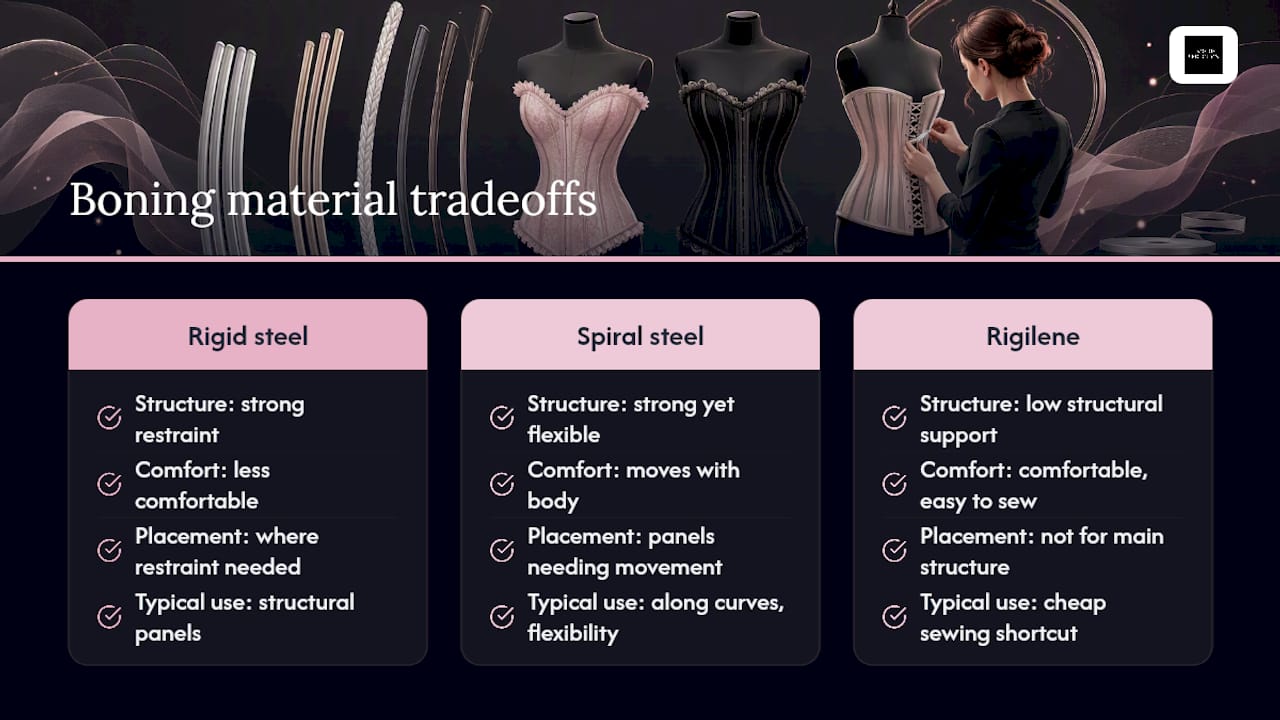
The conventional advice to “just use steel, it’s stronger” ignores comfort entirely, and the equally common shortcut of defaulting to Rigilene because it is cheap and easy to sew ignores structure entirely. Neither answer serves a maker well on its own. The strongest corsets, historically and now, mix materials deliberately: rigid steel where the body needs restraint, flexible synthetic where it needs to move.
If you take one thing from all of this, prioritise matching material to panel function over matching material to budget or habit. A corset with the right boning in the wrong place will disappoint you every time you wear it, no matter how well it was sewn.
— Lingerie Seduction
Prefer a ready-made boned corset over a DIY project?
Building a corset from scratch rewards patience, but not every wardrobe gap needs a sewing project attached to it. Boned corsetry and lingerie are available pre-cut, boned and finished, so you can skip the trial-and-error of sourcing steel, capping ends and testing casing tension yourself.

Pieces like the Luxury Ivory Shimmer Lace & Satin Bridal Teddy give you correct structure and a finished look without a single metre of boning to buy. Shipping and return policies vary; please check the retailer’s site for details. Browse the Luxe Black & Nude Lace Corset Lingerie now and get a properly boned corset without touching a wire cutter.
Sources
- 10 Types Of Corset Boning For Historical Corsetry — Sew Historically
- Boning information — Corsetmaking
FAQ
What type of boning is best for corsets?
Steel, particularly a mix of flat steel down the centre front and spiral steel through the side panels, gives the most reliable structure for serious waist shaping. Synthetic whalebone is the better pick when comfort and moulding matter more than heavy reduction.
What size boning should I use for my corset?
Centre front channels typically take 6mm to 10mm flat steel, side and back panels suit 6mm spiral steel or German plastic, and lacing channels need reinforced bones wide enough to stop grommets tearing through.
What is the boning in corsets called?
The rigid strips sewn into corset channels are simply called boning, a name carried over from the whalebone (baleen) originally used before steel and synthetic alternatives took over.
What replaced whalebone in corsets?
Whalebone was replaced by steel and synthetic whalebone (German plastic), both of which recreate the flex and support of baleen without relying on an endangered material.


