

Corset size guide: measure, choose reduction, order size
Order a corset 4 to 7 inches (10 to 18 cm) smaller than your natural waist for most off the rack purchases, according to the standard corset sizing calculator formula. Which end of that range you land on depends on why you’re wearing it.
- Fashion or light support: 3 to 4 inches of reduction
- Everyday shaping: 5 to 6 inches of reduction
- Experienced waist training: 7 to 8+ inches, only for those with prior tight lacing experience
- Rounding rule: if your waist measurement lands on a half inch, round up rather than down
If your torso is unusually long or short, if you’re heavier through the ribs or hips than the waist suggests, or if you want serious reduction beyond 8 inches, an off the rack size may not lace evenly. Custom sizing is worth the cost in those cases.
Key Takeaways
Getting a corset size right depends on measuring your natural waist accurately and choosing a reduction that matches your experience and purpose.
| Point | Details |
|---|---|
| Take four measurements | Underbust, natural waist, high hip, and torso length are the numbers every corset size depends on. |
| Match reduction to purpose | Use 3 to 4 inches for fashion wear, 5 to 6 for everyday shaping, 7 to 8+ only with prior experience. |
| Check rib and hip spring | Subtract your waist from underbust and hip measurements to find panel shapes that suit your torso. |
| Round up on half inches | If a measurement lands between whole numbers, round up rather than down for comfort. |
| Ask Lingerie Seduction for help | Lingerie Seduction offers free sizing advice before you order and confirms measurements for custom requests. |
Table of Contents
- Corset size guide: how to measure yourself correctly
- How do I pick the right corset size for my body?
- What are rib spring and hip spring, and why do they matter?
- Off the rack or custom: which corset should you order?
- What should a well-fitting corset feel like on first try-on?
- What does a corset size number actually mean?
- Get sizing help before you order your corset
- Sources
- FAQ
Corset size guide: how to measure yourself correctly
Getting an accurate corset size guide result starts with four numbers: underbust, natural waist, high hip, and torso length. Add full bust if you’re shopping for an overbust style. Skipping any one of these is the most common reason a “correct” size still doesn’t sit right.
- Underbust: Wrap the tape directly under your bust, parallel to the floor. Breathe normally and don’t compress the tape.
- Natural waist: Find the point where you bend side to side, roughly 1 inch above your belly button, and measure over bare skin or a well-fitting bra. This is the number every other measurement gets checked against.
- High hip: Measure around the widest point of your upper hip, usually 3 to 4 inches below the waist.
- Full bust (overbust styles only): Measure across the fullest part of the bust with the tape level at the back.
- Torso length: Sit on a firm, flat chair. Measure from just under the breast down to the crease where your thigh meets your hip.
A few habits separate an accurate corset measuring guide from a guessing game. Measure over bare skin or thin, fitted fabric, never over a jumper. Keep the tape level all the way around, not angled up at the back. Measure at the end of the day when your body has settled from daily movement, and take each measurement twice, then average the two.
Pro Tip: Torso length trips up more shoppers than any other number. Sit on a hard chair, not a couch, and if your result comes out under 8 inches, you’ve almost certainly measured standing or on a soft surface. Re-take it seated.
How do I pick the right corset size for my body?
Your natural waist minus your intended reduction gives you the corset size to order. The size itself isn’t the hard part. Choosing the reduction is.
- 3 to 4 inches: mild fashion wear, worn occasionally, minimal compression
- 5 to 6 inches: everyday shaping under clothing, worn several hours at a time
- 7 to 8+ inches: reserved for experienced wearers building up reduction gradually over months
Two people with the same 28 inch waist can need different sizes. Softer, more compressible torsos (more soft tissue relative to muscle and bone) generally tolerate a slightly larger reduction comfortably than someone with a firmer, more muscular midsection. A shorter torso will also feel a given reduction more intensely than a longer one, because there’s less surface area to distribute the pressure.
Some worked examples:
- 30 inch waist, first corset, fashion wear: order a size 26 (4 inch reduction)
- 32 inch waist, everyday shaping: order a size 27 (5 inch reduction)
- 26 inch waist, experienced wearer: order a size 19 or 20 (6 to 7 inch reduction)
If your calculation lands on a half inch, round up to the next whole size rather than down. A slightly generous corset can be laced tighter over time. A too-small one just won’t close.
What are rib spring and hip spring, and why do they matter?
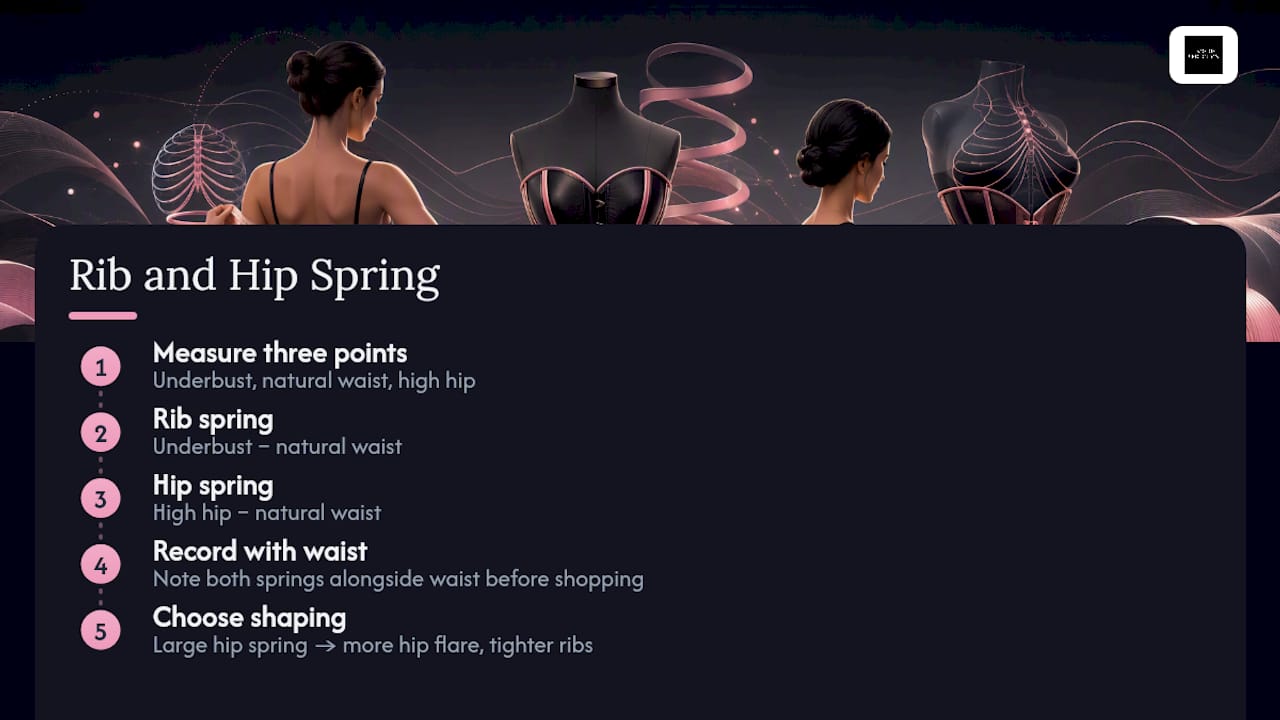
Rib spring is the difference between your underbust and your natural waist. Hip spring is the difference between your high hip and your natural waist. Together they describe your torso’s shape, not just its size.
A corset with the right waist number can still feel wrong if its internal shaping doesn’t match your rib and hip spring. Someone with a large hip spring but a modest rib spring needs a corset cut with more flare at the hip and a tighter taper through the ribs, or the panels will gap or dig depending on where they sit.
To work out your own numbers, subtract your waist from your underbust for rib spring, then subtract your waist from your high hip for hip spring. Sizing calculators commonly ask for these two figures alongside your waist, because they let you filter stock toward panel shapes built for your proportions rather than just your circumference. Note both figures next to your waist measurement before you shop, and use them to compare styles, not just sizes.
Off the rack or custom: which corset should you order?
An off the rack corset works for most people whose rib spring and hip spring fall within typical ranges and whose reduction goal sits under about 6 inches. It’s faster, cheaper, and available immediately from a curated range like Lingerie Seduction’s corset and bustier collection.
- Off the rack: lower cost, ships immediately, needs only 4 core measurements, fit is close but not exact
- Custom (made-to-measure): higher cost, longer lead time, but built to your exact shape
Custom builds typically need 14 to 22 measurements, including multiple vertical lengths, several circumferences at different points, and sometimes shoulder or underbust asymmetry notes.
Consider custom if your proportions sit well outside average (very long or short torso, large gap between rib and hip spring), you have a medical or postural need for precise support, or you’re chasing a reduction goal beyond 8 inches. For anything less extreme, a well-chosen off the rack piece, like the underwire corset styles designed for adjustable back lacing, will usually do the job.
What should a well-fitting corset feel like on first try-on?
A correctly sized corset sits at your natural waist without needing to be yanked up or down. Check these points before you decide it’s the right fit:
- Sits at your natural waist, not riding up toward the ribs or slipping to the hips
- No boning digging into your ribs or hip bones
- No rolling or gapping at the top or bottom edge
- You can breathe comfortably, even if snugly
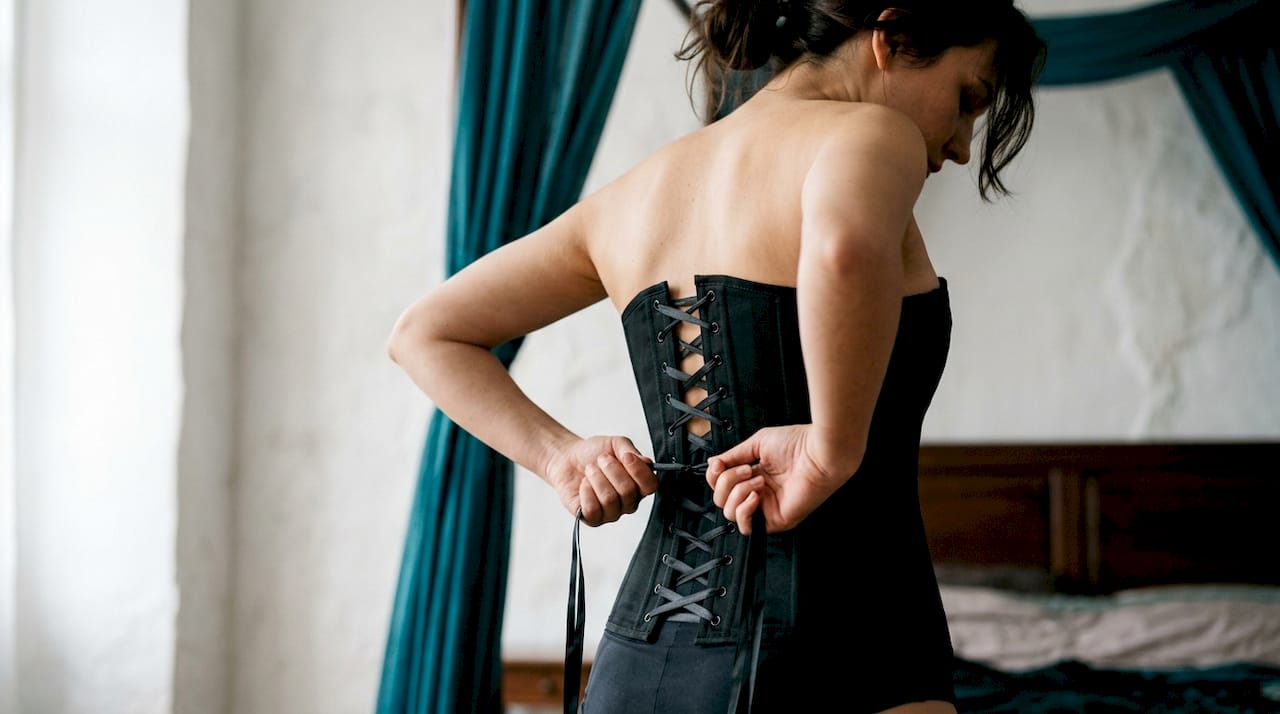
- The back lacing gap is even, roughly 1 to 2 inches on each side, not laced fully closed
If the bust gaps, the cup style doesn’t suit your shape. Add a bust pad or try an underbust style instead. If rib bones dig in, the panel length or shape doesn’t match your torso. A shorter-length corset or different paneling usually fixes it. If the corset rolls at the top when you sit, your torso length was likely under measured.
Stop immediately if you feel sharp pain, numbness, or restricted breathing beyond normal snugness. That’s not something to lace through. It means the size or style is wrong, not that you need to “break it in”.
What does a corset size number actually mean?
A labelled size, say, a size 22, is the corset’s internal waist measurement when fully closed. It’s not your body measurement. The gap between that number and your natural waist is your reduction.
- Start with your natural waist: 30 inches
- Apply a 6 inch reduction for everyday shaping: 30 minus 6 equals 24
- Order a size 24, expecting a moderate lacing gap on first wear
| Corset size (inches) | Approximate centimetres |
|---|---|
| 20 | 51 |
| 22 | 56 |
| 24 | 61 |
| 26 | 66 |
| 28 | 71 |
- A fully closed corset should still leave a small lacing gap at the back on day one, not sit laced shut
How Lingerie Seduction approaches corset sizing
We help shoppers confirm measurements before ordering, and check them again before finalising any made-to-measure request…
Get sizing help before you order your corset
Picking between a size 24 and a size 26 shouldn’t come down to guesswork, and it doesn’t have to. Lingerie Seduction offers free sizing advice before you buy, so you’re not left second-guessing a measurement or a reduction band on your own.
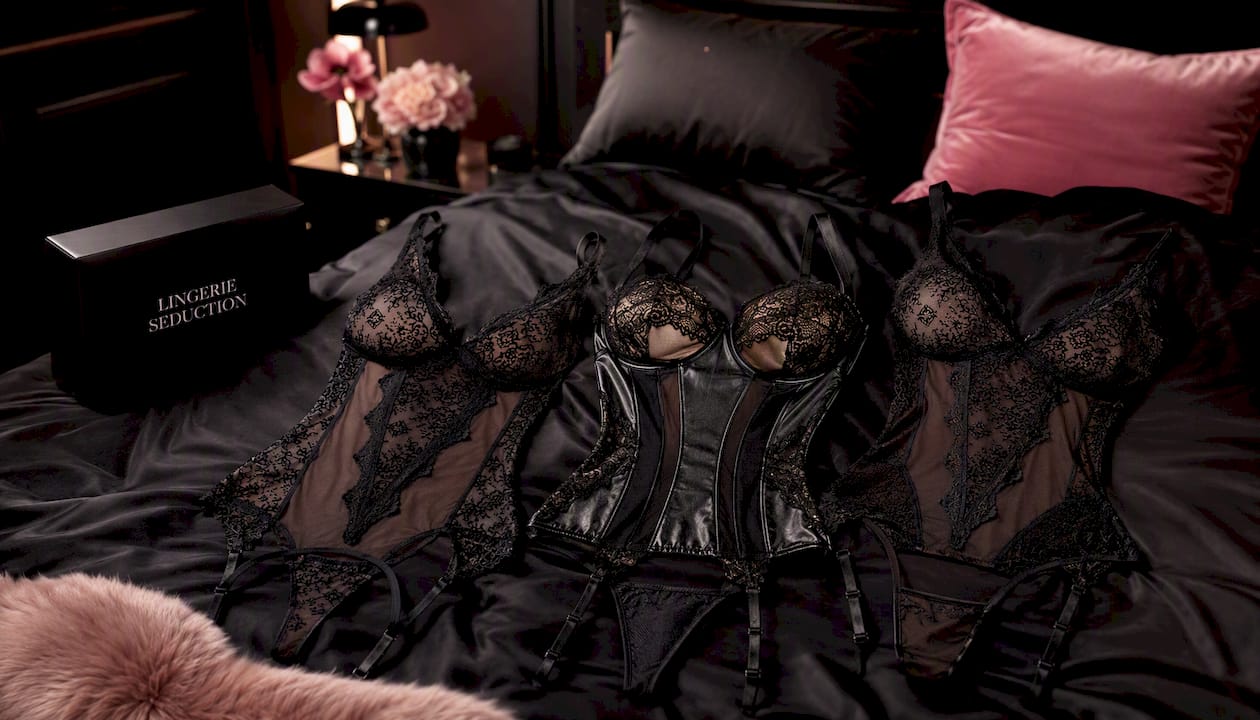
Every corset and bustier in the curated collection ships with discrete packaging and fast local dispatch, backed by hassle-free returns if the fit isn’t quite right on arrival. Orders over $100 also qualify for free shipping. If you’re weighing up a structured piece against something softer for the same occasion, the Sexy Black Lace & Microknit Sleepwear Set and the Luxury Sheer Mesh & Lace Women’s Babydoll Set are both worth a look. For a fitted foundation piece to pair under either, browse the Luxe Black Lace Cami Lingerie Set.
Take your four core measurements using the steps above, then message the team with your numbers before you check out. It’s the fastest way to land on the right size the first time.
Sources
- Determine Your Corset Size and your “Spring” measurements - Corset Database
- Submitting your measurements – Lucy’s Corsetry
- How to Measure Yourself for a Corset (And Actually Get the Right Size) – French Meadows
- Corset Size Calculator & Fit Guide - Kilt & Jacks
FAQ
How do I know my corset size?
Measure your natural waist, then subtract 4 to 7 inches depending on your intended reduction. A 30 inch waist with a 5 inch reduction means ordering a size 25 or 26.
What size is a size 22 corset?
A size 22 corset measures 22 inches (about 56 cm) around the internal waist when fully closed. Your natural waist will be larger than this by your chosen reduction amount.
What is a size 32 in a corset?
A size 32 corset has a 32 inch internal waist measurement when laced closed. It suits someone with a natural waist larger than 32 by the chosen reduction amount, which varies depending on their reduction goal.
Do you size up or down for corsets?
Size down from your natural waist by your chosen reduction, typically 4 to 7 inches for off the rack corsets. If a measurement falls on a half inch, round up rather than down for comfort.
Should I buy off the rack or custom if my measurements fall between sizes?
If your rib spring and hip spring are fairly typical, round up to the nearest off the rack size. If your proportions are unusual or your reduction goal exceeds 8 inches, custom sizing is worth the extra lead time.
Tags: corset size guide, how to measure for a corset, corset fitting tips, corset size chart, adjustable corset sizes, corset measuring guide


