

AU Bands Are 20 Below US: AU Bra Size Conversion With Exact Table
To convert an AU bra size, match your band number to the same figure in UK sizing, then adjust the cup letter against the US or EU equivalent using a conversion table. Band numbers stay mostly consistent across AU and UK, but cup letters shift once you pass a DD, and US charts sometimes label the same cup as DDD or E. Check the table below for exact matches before you buy.
TL;DR:
- The difference in measurement is key, as AU cup sizes are based on centimeters of bust-overbust difference, not fixed cup letters.
- Australian band sizes align closely with UK sizes, but US and EU charts often label the same physical size differently, especially in larger cups.
- Brands vary in cup volume for the same letter past DD and in band stretch over time, so fitting through sister sizing or trial is often necessary.
- Accurate measurement of underbust and overbust, rounded properly, is crucial to determine the correct starting size, but fit issues may still require adjustments.
- Retailers like Lingerie Seduction rely on conversion tables as a starting point, with returns and fitting advice available to compensate for sizing inconsistencies.
Table of Contents
- AU bra size conversion: the master table for UK, US and EU
- How do you measure your underbust and overbust at home?
- Why does AU sizing look different to UK, US and EU charts?
- What do real AU-to-international conversions look like?
- How does Lingerie Seduction apply these sizing standards?
- Where did Australian bra sizing come from?
- What sizing issues do Australian brands run into most?
- Does body shape change which AU bra size actually fits?
- Why sizing charts are a starting point, not the final word
- Shop your converted size at Lingerie Seduction
- Where to check your size before you buy
- Sources
- FAQ
AU bra size conversion: the master table for UK, US and EU
Getting an accurate match comes down to two things: your band number and your cup letter, both converted separately. The band stays close to identical between AU and UK for almost every mainstream brand, which is one of the few genuinely simple parts of this whole system. Cup letters are where the real conversion work happens, especially once you’re shopping US or European brands.
Standard conversion charts put AU 10 = US 30 = UK 10 = EU 65, and the pattern holds fairly predictably through the mid-sizes. Here’s the full band and cup matrix for the sizes Australian shoppers search for most.
(size details vary by brand; check brand charts)
| — | — | — | — |
(size details vary by brand; check brand charts)
| — | — | — | 100G |
(size details vary by brand; check brand charts)
Band sizes from Bras N Things’s fit guide show this same AU to US relationship: AU 12 = US 32, AU 14 = US 34, AU 16 = US 36, with each AU band sitting a flat 20 below its US number. That’s a handy mental shortcut when you’re staring at a US size chart with no AU column in sight.
Cup sizing works differently. It’s based on the difference between your overbust and underbust measurements, not a fixed number, which is why the same band can carry wildly different cup letters depending on your shape. Use this quick reference to translate a measurement difference into an AU cup letter.
| Bust difference (cm) | AU cup |
|---|---|
| 10–12 | A |
| 12–14 | B |
| 14–16 | C |
| 16–18 | D |
| 18–20 | DD |
| 20 | E |
| 22 | F |
| 24 | G |
| 26 | H |
To use either table, match your band first (that part rarely changes across systems), then find your cup using the bust difference. If a brand runs small or large for your shape, that’s where sister sizing helps: going up a band and down a cup (or the reverse) gets you a size with the same cup volume but a different fit around the ribcage. Retailers commonly host dedicated AU conversion pages precisely because this cup logic trips up so many online shoppers.
How do you measure your underbust and overbust at home?
Getting the conversion table right depends entirely on getting your own measurements right first. A soft tape measure and five spare minutes are all you need, done in a well-fitted (or no) bra, standing straight.
- Measure your underbust by wrapping the tape firmly around your ribcage, directly under the bust, keeping it level all the way round.
- Round to the nearest even number. Myer’s bra fitting guide uses the example of a 76 cm underbust reading translating straight to a band size 12.
- Measure your overbust at the fullest part of your bust, tape sitting level and not too tight.
- Subtract underbust from overbust. The difference in centimetres is what determines your cup, using roughly every 2 cm as one cup size up from AA.
- Cross-check against the cup table above to land on your AU letter.
If your underbust lands on an odd number, round up rather than down. A 75 cm reading becomes a 76, which converts to a band 12, not 10. Guessing down tends to land women in a band that’s too tight, which is the single most common fit complaint in online bra shopping.
Pro Tip: If the band rides up at the back or the centre gore won’t sit flat against your sternum, try going down a band and up a cup before assuming the whole size is wrong. That’s sister sizing in action, and it fixes more “bad fit” bras than buying an entirely different size does.
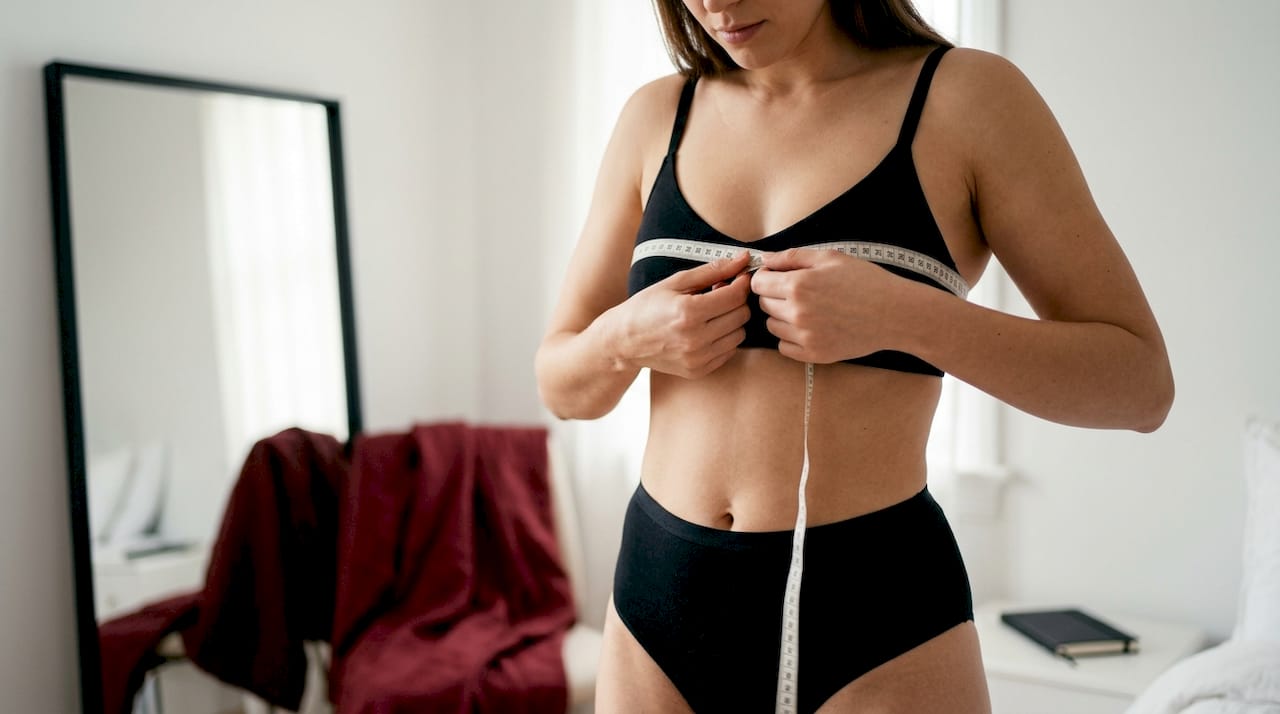
For a slower walkthrough with photos, Lingerie Seduction’s bra size measurement guide covers the same steps with a bit more detail on posture and tape placement.
Why does AU sizing look different to UK, US and EU charts?
Band numbers are the easy part. AU and UK use functionally identical band numbering for nearly every mainstream brand, so a band 14 in one system is a band 14 in the other. Cup letters are where things get genuinely messy, and it happens specifically at the larger end of the range.
- AU and UK both run A, B, C, D, DD, E in lockstep for smaller cups.
- Past DD, UK charts often insert an FF step that AU sizing skips, so an AU F can land as a UK FF depending on the brand.
- US charts frequently label AU E or F cups as DDD or even DDDD, because the American convention repeats the D rather than progressing to new letters.
- EU bands are expressed in centimetres, not the AU numbering scale. A band that reads AU 10 shows up as EU 65; AU 14 becomes EU 75.
The naming mismatch is common enough that Bras N Things’ conversion guidance specifically flags AU E as often equating to US DDD, and warns that the exact match depends on the individual brand’s own chart. This is not a rare edge case. Once you’re past a DD cup, roughly one in three international size charts will use a completely different labelling convention for what is physically the same cup volume, which is exactly why checking the specific brand’s own chart matters more than trusting a generic conversion formula.
If in doubt, treat the band number as reliable and the cup letter as a starting point to verify, not a guarantee.
What do real AU-to-international conversions look like?
Seeing the numbers side by side makes the whole system click faster than any formula. Here are the conversions Australian shoppers ask about most often.
- AU 10A converts to US 30A, UK 10A, and EU 65A. Cup naming stays consistent this small.
- AU 12C becomes US 32C, UK 12C, EU 70C. Still a clean, direct match.
- AU 14D maps to US 34D, UK 14D, EU 75D. The last size where every system tends to agree.
- AU 16D sits at US 36D, UK 16D, EU 80D.
- AU 16DD often shows as US 36DDD rather than 36DD, because US sizing skips straight past the double D naming AU uses.
- AU 14E typically appears as US 34DDD, UK 34E, EU 75F. Notice the UK figure matches AU far more closely than the US one does.
- AU 18F can show up labelled US 38DDD or occasionally 38G, depending entirely on the brand.
If a US-branded site lists only “36DDD” and you’re not sure whether that’s your AU 16DD or 16E, switch your filter to the UK size chart instead of the US one. UK cup letters track far closer to AU than American ones do, which makes UK sizing the safer fallback whenever a fuller cup range feels ambiguous. When searching Australian retailers directly, search by band and cup together (e.g. “16DD”) rather than relying on a single filter tag, since not every store lists every cup letter as a separate filter option. Readers chasing an extended cup range will find more direct matches on Lingerie Seduction’s inclusive sizing guide.
How does Lingerie Seduction apply these sizing standards?
Fit recommendations generally follow the same AU band and cup logic covered above, cross-checked against standard retailer conversion charts rather than a single brand’s in-house scale.
- The full Australian lingerie size chart lays out band and cup equivalents across the whole AU range, so you can check a style before buying.
- Free shipping on orders over $100 and hassle-free returns mean trying a converted international size carries close to no risk if the fit is slightly off.
- Discrete packaging applies to every order, which matters if you’re testing a size you’re not fully certain about.
- Shoppers with harder-to-match cup sizes can start with the inclusive sizing lingerie guide rather than guessing from a generic chart.
If a converted size still feels uncertain once the item arrives, that’s exactly what the returns policy is there for.
Where did Australian bra sizing come from?
AU sizing developed from the same British underwear industry standards that shaped most of the Commonwealth, which explains why AU and UK bands still line up so closely today. Both systems trace back to a mid-20th century shift in lingerie manufacturing, when brands moved from generic “small, medium, large” labelling to a numeric band paired with a lettered cup, a system credited to reducing fit complaints once measurement became standardised across retailers.
Australia largely inherited the British approach rather than developing an independent standard, which is why the two countries still share band numbers almost exactly. The divergence happened later and mostly in cup letter progression. As underwear manufacturing globalised through the late 20th century, American brands built their own cup naming convention, repeating “D” instead of introducing new letters past a double D. That single manufacturing choice is the root of most of the confusion Australian shoppers hit today when browsing US sites.
Meanwhile, European manufacturers standardised around metric underbust measurements rather than adopting either English-language cup lettering system outright, which is why EU sizes read as plain centimetre numbers like 70 or 75 instead of a number-letter combination.
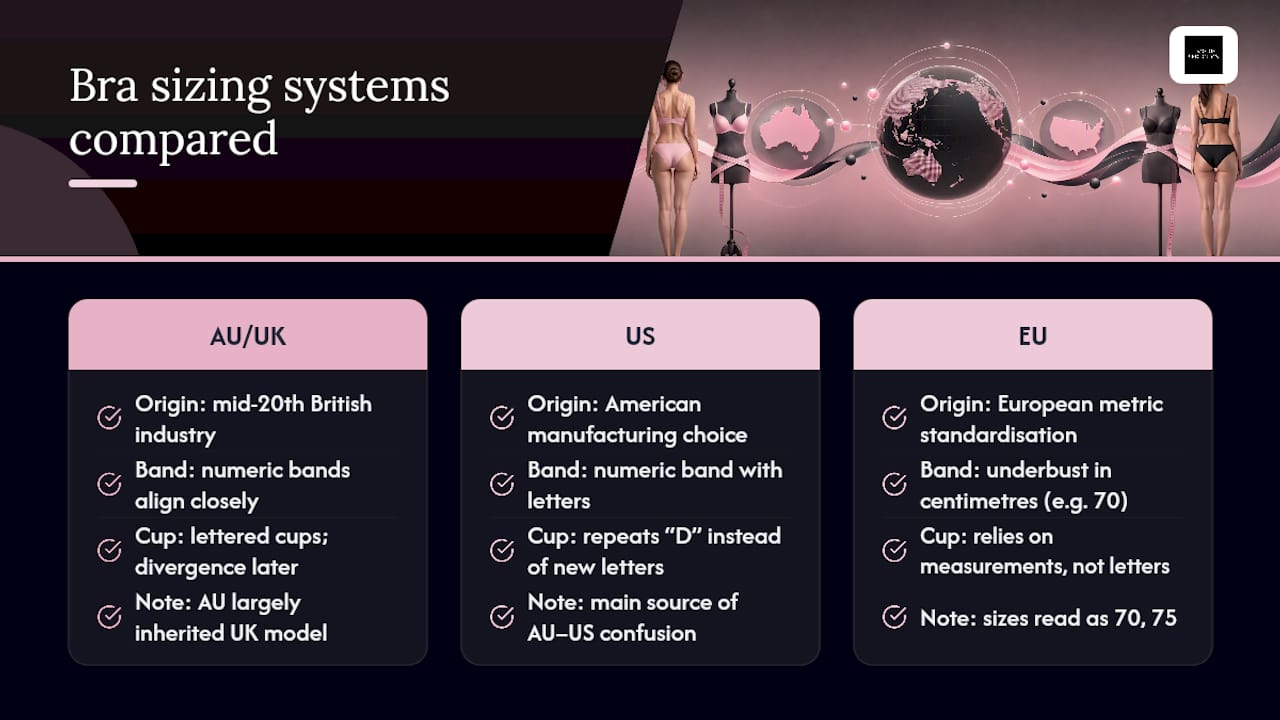
The practical result: three systems that all started from a similar idea (measure the band, measure the cup) but drifted apart in execution. AU sizing sits closest to the UK model, which is worth remembering any time a size label doesn’t seem to add up.
What sizing issues do Australian brands run into most?
Australian brands generally run truer to the AU/UK cup model, but a handful of consistent issues still show up across the local market.
The biggest one is inconsistent cup progression once you’re past a DD, even between two Australian-made brands. One AU label’s “F” cup can fit like another Australian brand’s “E,” because there’s no single enforced manufacturing standard governing exactly how much fabric volume each cup letter represents. Unlike shoe sizing, which follows a fairly rigid last measurement, bra cup letters are closer to a guideline than a fixed spec.
A second recurring issue is band stretch variance. Cheaper elastic bands lose their fit faster, which means a size that measured correctly at purchase can run a full band size looser within a few months of regular wear. This is particularly noticeable in budget multi-packs versus structured pieces built with firmer boning or underwire support.
Plus-size AU ranges also tend to jump in bigger increments than core sizing, sometimes skipping a band or cup step entirely between the standard range and the extended range. That gap is exactly why checking a brand’s own size chart, rather than assuming a universal AU standard applies everywhere, matters more in the extended sizes than anywhere else in the system.
Does body shape change which AU bra size actually fits?
Two women with an identical band and cup number can need completely different bra styles, because torso shape, breast tissue distribution, and root width vary independently of the measurements the AU sizing system captures.
A wider-set bust needs a bigger bridge and wider wire than a closer-set bust of the same cup volume, even though both measure identically on paper. Fuller-on-bottom breast shapes often need more coverage in the lower cup than a standard balconette style provides, regardless of what the size label says. Someone with a fuller ribcage relative to their cup size may find that going up a band and down a cup, the sister sizing move covered earlier, solves a fit issue that the “correct” converted size never would.
Posture and ribcage shape matter too. A more pronounced natural arch in the back changes how a band sits, which is part of why the same converted AU size can feel completely different in a plunge style versus a full-coverage style from the same brand. None of this means the conversion table is wrong. It means the table gets you to a strong starting point, not a guaranteed perfect fit on the first try, which is exactly why trying the actual garment still matters more than any chart.
Why sizing charts are a starting point, not the final word
Conversion tables solve the maths problem. They don’t solve the fit problem, and treating them as interchangeable is where most online bra shopping frustration comes from.
Lingerie Seduction builds its size guidance around the same measurement logic covered in this guide, but every brand’s cut still varies slightly, which is precisely why returns exist as a safety net rather than an afterthought. If your converted size lands right on a boundary between two cups or bands, we’d rather you try it and send it back than talk yourself into the wrong size out of caution. For anything borderline, our fitting pages or customer service team are a faster path to a confident answer than guessing from a table alone.
— Lingerie Seduction
Shop your converted size at Lingerie Seduction
Once you know your AU band and cup, many retailers allow filtering by size and checking fit notes on each style, with returns often available if the fit is not quite right.

Structured styles behave differently to soft-cup ones, so matching your converted size to the right construction matters. The Open Cup Cage Bra & Garter Panty Set suits shoppers who’ve confirmed their band size precisely, since open-cup cage designs rely on an accurate underbust fit rather than cup coverage to sit correctly. For fuller cup ranges where US labels tend to confuse the picture, structured pieces like the Faux Leather & Lace Black Bustier With Gstring offer built-in boning that’s more forgiving of small cup miscalculations than a soft-cup bra would be. The Faux Leather & Mesh Black Bustier With Gstring uses a similar structured build with a mesh panel, a solid option if you’re between two converted sizes and want a style with some built-in adjustability through the lacing.
Orders over a certain amount may qualify for free shipping, returns policies may be hassle-free, and packaging can be discrete. Browse the range by your confirmed AU size and check product fit notes before purchase.
Where to check your size before you buy
- Australian Bra Size Guide with conversion charts
- Myer’s bra fitting guide
- Lingerie Seduction’s Australian size chart
- Dress size guide for cross-referencing measurements
Sources
- Australian Bra Size Guide: Every Size Explained (With Conversion Charts) | SmartKoala
- Bra Size Conversion Table (AU, UK, US & EU)
- Bra fitting guide | How to measure your bra size | Myer
- Bra size chart | Bras N Things fit guide
FAQ
How do I figure out my bra size in Australia?
Measure your underbust firmly for your band number, then subtract that figure from your overbust measurement to get your cup, using roughly every 2 cm as one cup letter up from AA.
What is a 32A bra size in Australia?
A 32A isn’t a standard AU label. AU sizing runs even band numbers (10, 12, 14), so the closest AU equivalent to a US 32A is an AU 12A.
What is a 36C bra size in Australia?
A US 36C converts to an AU 16C, since AU band numbers sit 20 below their US counterparts while the cup letter stays the same.
What is AU cup size?
AU cup size is a letter (AA through H and beyond) that represents the difference between your overbust and underbust measurement, with each roughly 2 cm increase moving up one cup letter.


